
How to Import Electric Three-Wheelers and Four-Wheelers into Europe | QIDI EV
Buying the vehicle is only step one. For a European distributor, the real work starts with vehicle classification, customs clearance, type approval, conformity documentation and local registration.
QIDI EV coordinates these stages with dealers before production and shipment, so the configuration and paperwork already match the destination market — instead of discovering a mismatch after the container arrives.
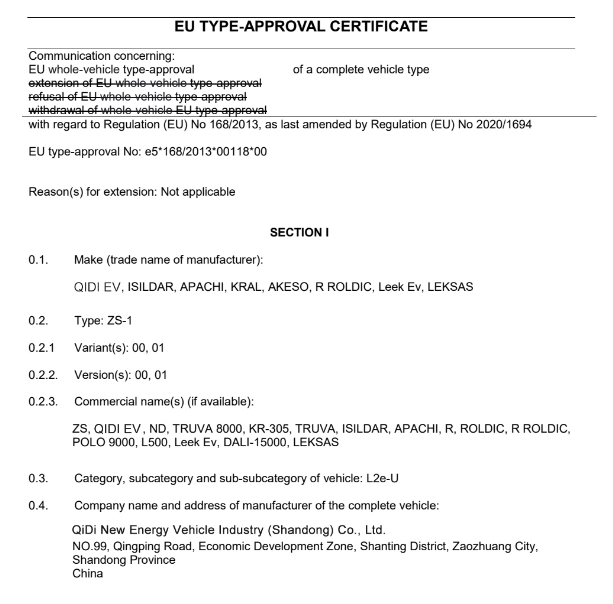
For L-category vehicles, EU Regulation No 168/2013 covers L2e, L5e, L6e and L7e, and defines the Certificate of Conformity (CoC) that proves a produced unit matches its approved type.
1. Pick the Right Vehicle and Approval Category First
Before ordering, a dealer should confirm three things: which vehicle, which approval category, and whether the exact production build matches the approved type.
Typical QIDI EV models by use case
- NIO Mini – compact electric four-wheel truck
- NIO A8H – four-wheel commercial vehicle
- TANK 90 – lightweight agricultural utility vehicle
- Land Cruiser – electric cargo three-wheeler
- Aurora A8 – enclosed passenger electric three-wheeler
A marketing name like “electric mini truck” or “e-tricycle” is not a legal approval category. The vehicle’s technical characteristics decide the regulatory treatment.
2. Customs Clearance: What a European Dealer Actually Needs
An EORI number is mandatory for any EU customs operation. The import file covers importer/exporter details, goods description, quantity, value, origin, transport data and supporting docs.
QIDI EV prepares or supports the buyer with:
- Commercial Invoice & Packing List
- Bill of Lading
- Vehicle Specification Sheet & chassis/serial records
- Type-approval file and CoC (where applicable)
- Battery documentation (UN38.3, MSDS)
- Any destination-specific customs or registration papers
Dealers should also confirm the TARIC classification, duty, VAT and country-specific rules before shipment. The tariff follows the technical build, not the product nickname.
Correct classification is not the same as dodging duty. A wrong HS code to save a few points can trigger reassessment, back-charges and weeks of delay.
3. After Clearance: Registering the Vehicle in Europe
Registration authorities check the CoC to confirm the unit matches an approved type. A valid EU CoC is generally recognised across member states, but local registration formalities still apply.
QIDI EV supports the chain dealers actually need:
Type-approval info → CoC documentation → VIN / spec records → registration support
The dealer is not “borrowing QIDI’s certificate” as a generic PDF. The registered vehicle must correspond to the approved type, and EU rules require the manufacturer to maintain production conformity and account for any change to the approved build.
4. L-Category Quick Reference
L2e
Three-wheel moped — low power, limited speed.
L5e
Three-wheel vehicle / tricycle, cargo or passenger variant.
L6e
Light quadricycle — up to 4 kW, ~45 km/h, campus/resort use.
L7e
Heavy quadricycle — up to 15 kW, the sweet spot for electric mini trucks and light pickups.
The final category is confirmed from the approved technical file — never picked to match a dealer’s preferred registration label.
5. Can an Approved QIDI Vehicle Be Customized?
Yes — but appearance changes and technical changes are not treated the same.
Usually fine without re-approval
- Exterior color, branding, decals, cosmetic trim
Needs assessment or type-approval amendment
- Motor power, top speed, battery spec
- Brakes, suspension, dimensions, lighting
- Seating, mass/load ratings, safety components
Regulation 168/2013 sets a formal amendment process for changes to the approved information package. QIDI EV’s practical rule: confirm the configuration before production, not after the certificate lands.
6. CBU or SKD? What a One-Unit Dealer Actually Needs
CBU — Complete Built Unit
Arrives ready to drive. Best for single-unit orders, demos, market testing and the simplest registration path.
Indicative volume: ~7 m³ → ~US$1,400 at US$200/m³.
SKD — Semi Knocked Down
Partially disassembled for better container use. Best for volume programs with local assembly capability.
Indicative volume: ~5 m³ → ~US$1,000 at US$200/m³.
These are budgetary examples only — actual freight varies by port pair, FCL/LCL, surcharges and destination handling. And ocean freight is never the full landed cost: duty, VAT, broker fees, inland transport and registration sit on top.
For a dealer buying one unit to evaluate and register, CBU is almost always the lower-risk start. SKD only pays off once there’s volume and a workshop to assemble it.
7. QIDI EV’s 9-Step European Import Workflow
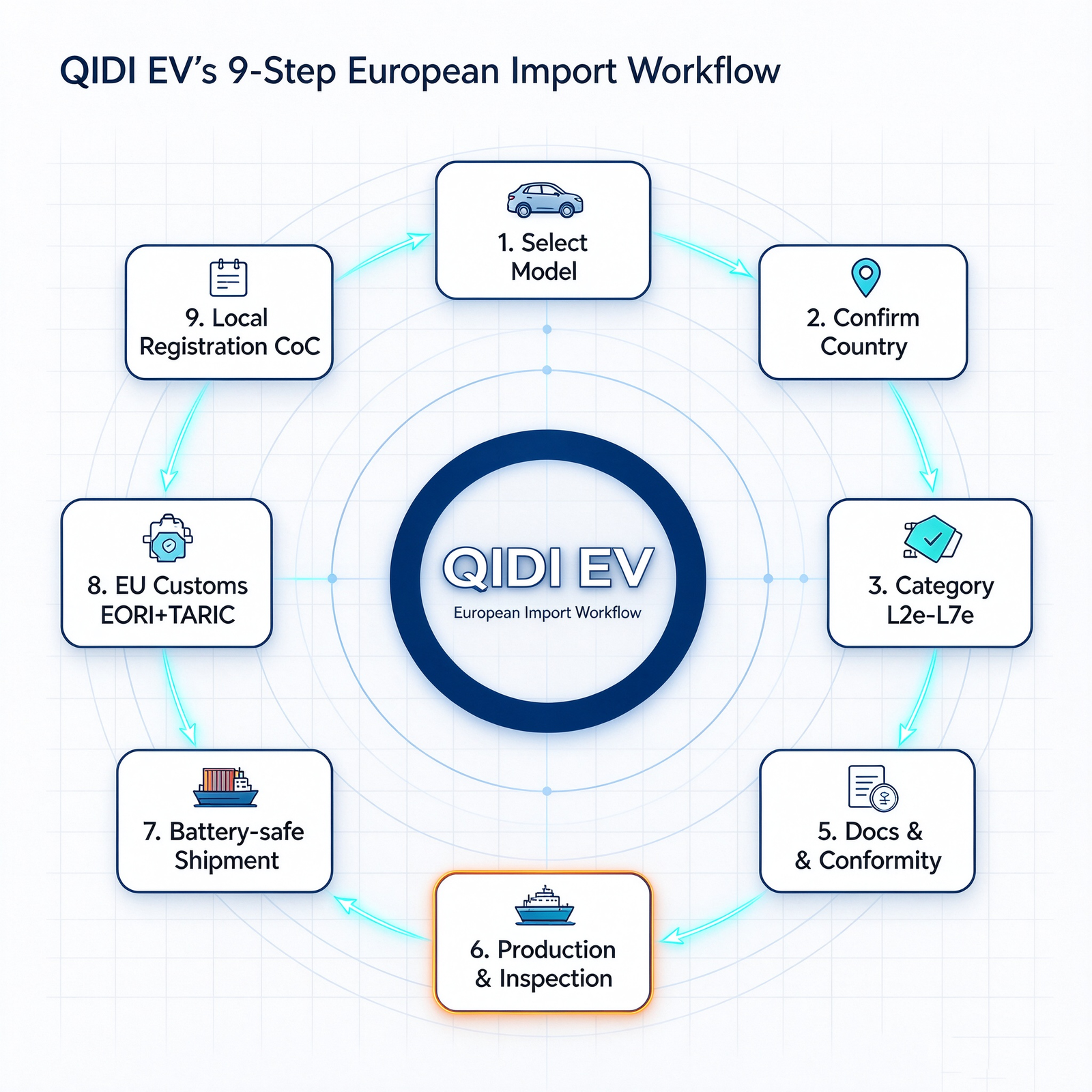
- Select model — NIO Mini, NIO A8H, TANK 90, Land Cruiser, Aurora A8.
- Confirm destination country and its local registration rules.
- Confirm approval category (L2e / L5e / L6e / L7e) against the spec.
- Choose CBU or SKD based on order size and assembly capacity.
- Prepare customs + conformity docs before production closes.
- Production & pre-shipment inspection to the approved build.
- Container loading & ocean shipment with battery-safe packing.
- EU customs clearance handled by the dealer’s broker (EORI + TARIC).
- Local registration using QIDI EV’s CoC and technical records.
8. Dealer Case: One Unit, SKD Temptation Avoided
A European distributor wanted a single four-wheel vehicle to test local demand and initially asked for SKD because the per-unit freight looked cheaper on paper.
QIDI EV flagged three realities: no local assembly experience, only one demonstration unit needed, and the vehicle had to be road-registered. The recommendation was a CBU unit in an already-approved configuration.
Coordinated chain: configuration confirmation → production → CoC & technical docs → export packing → ocean shipment → customs document support → registration paperwork.
The dealer skipped building an unnecessary assembly line and went straight to showing the vehicle to local customers. When demand is confirmed, a larger CBU or SKD program can be scoped then — not forced upfront.
Conclusion: Importing Is a Process, Not a Shipment
Successful European imports tie together vehicle selection, customs classification, conformity, logistics and registration. QIDI EV supports dealers across that chain with NIO Mini, NIO A8H, TANK 90, Land Cruiser and Aurora A8.
The principle stays the same: build the right vehicle, ship it correctly, hand over the right CoC, and help the dealer register it without avoidable surprises. Decide the configuration and approval category before production and before shipment — that is what turns an international shipping headache into a structured import project.
Planning a first European unit and want the CoC + TARIC check done before you quote?
Request a dealer briefing from QIDI EV →