
Why Electric Three-Wheelers Are Taking Over Global Markets: Trends, Prices and Import Tariffs
Why Electric Tricycle Are Becoming Popular Worldwide: Global Market Trends, Prices and Import Tariffs
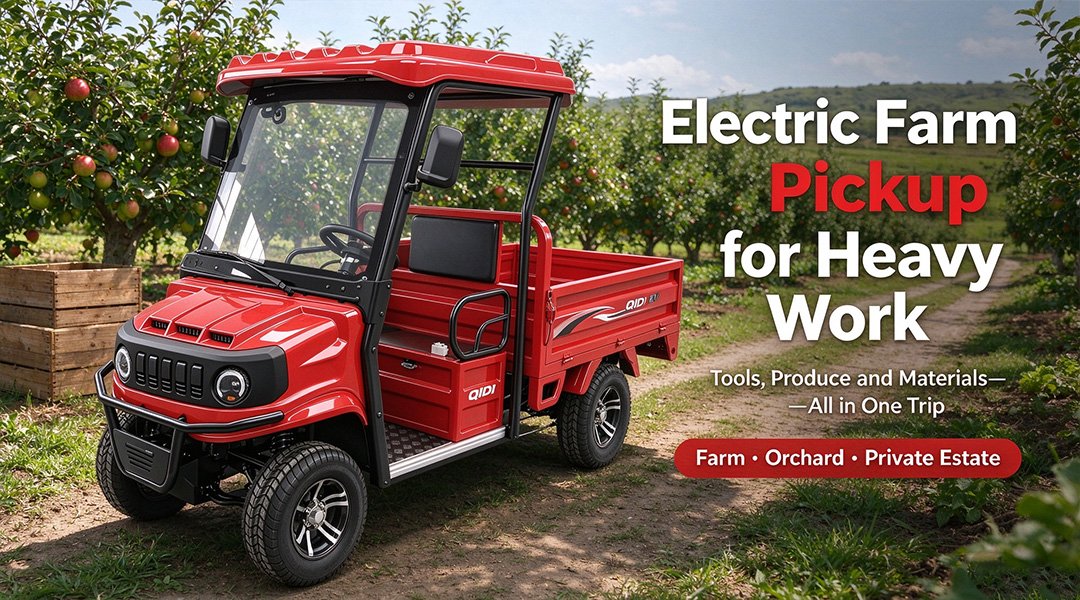
Electric three-wheelers are becoming an increasingly important part of the global electric mobility market. From cargo transportation in India to passenger tuk-tuks in Southeast Asia and commercial delivery vehicles in Africa, these compact vehicles are helping businesses and individuals solve everyday transportation problems.
Their popularity is not simply about electrification. It is about affordability, practicality, low operating costs and the ability to transport passengers or goods in places where conventional vehicles are too expensive or inconvenient.
At the same time, electric four-wheel mini trucks and utility vehicles are creating new opportunities for farms, warehouses, industrial facilities and local delivery businesses.
So, why are electric three-wheelers becoming popular, which markets offer the strongest opportunities, and what should importers know about customs duties and vehicle certification?
1. Why Are Electric Three-Wheelers Becoming Popular Worldwide?
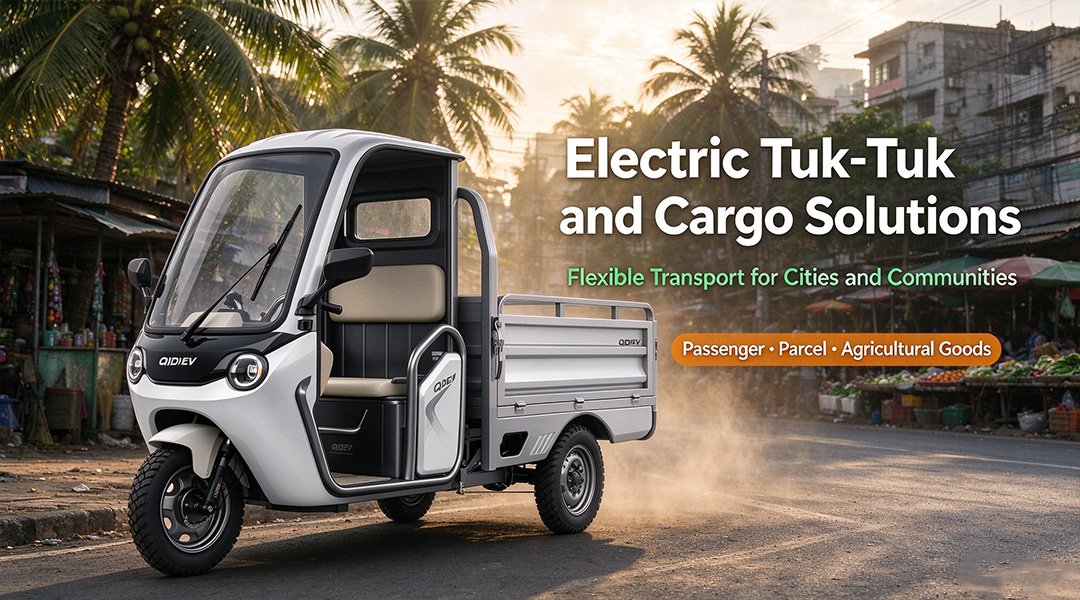
Electric three-wheelers have several advantages that make them attractive in both developing and established markets.
- Affordable transportation: Compared with conventional passenger cars and commercial vans, electric three-wheelers generally require a lower initial investment. This makes them accessible to small businesses, independent operators and local transport companies.
- Lower daily operating costs: Electricity can cost less than petrol or diesel for equivalent short-distance operations. Electric drivetrains also have fewer routine mechanical maintenance requirements than conventional combustion engines.
- Flexible transportation: A three-wheeler can be configured for passenger transportation, parcel delivery, agricultural products, market goods or industrial materials.
- Suitable for short-distance routes: Many businesses do not need a vehicle capable of travelling hundreds of kilometres every day. They need a reliable vehicle for repeated local trips.
- Compact dimensions: Three-wheelers can be easier to manoeuvre and park in crowded streets, markets, small farms and narrow working areas.
These advantages make electric three-wheelers particularly relevant to countries where affordable local transportation is an important part of the economy.
2. Global Electric Three-Wheeler and Four-Wheeler Market Analysis
According to the International Council on Clean Transportation (ICCT), global three-wheeler sales reached approximately 2.1 million units in 2025, an increase of 9% compared with 2024.
Electric three-wheeler sales grew by more than one-third and accounted for approximately half of all global three-wheeler sales. This is an important sign that electrification is moving beyond passenger cars and entering everyday commercial transportation.
The market remains geographically concentrated:
- India accounted for approximately 78% of global electric three-wheeler sales.
- Türkiye represented around 10%.
- China accounted for approximately 7%.
Together, these three markets represented approximately 95% of global electric three-wheeler sales in 2025.
The broader electric light commercial vehicle market is also expanding. The International Energy Agency (IEA) reported that global electric LCV sales exceeded 430,000 units in 2025, growing approximately 45% year on year. Europe and China accounted for around 80% of these sales.
However, electric mini trucks and L7e quadricycles are not the same market segment as conventional electric vans. Their customer requirements, vehicle classifications and price levels are different.
Regional Market Opportunities
| Region | Main market opportunities | Potential customer groups |
|---|---|---|
| North America | Utility transportation, resorts, farms and private estates | Farms, property managers, tourism operators |
| European Union | Urban logistics, agricultural transport and compact utility vehicles | Distributors, warehouses, farms, municipal services |
| Africa | Passenger tuk-tuks, cargo transport and local delivery | Transport operators, traders, small businesses |
| Southeast Asia | Passenger tuk-tuks, parcel delivery and agricultural transportation | Delivery companies, markets, farmers |
| South Asia | Electric rickshaws, cargo tricycles and last-mile logistics | Transport operators, wholesalers, small businesses |
| Central Asia | Farm transport, industrial sites and local goods delivery | Agricultural businesses, warehouses, industrial operators |
The strongest immediate three-wheeler markets are still concentrated in Asia. Africa has considerable potential because of its existing three-wheeler transport sector, although electric adoption is at an earlier stage in many countries.
In Europe and North America, the opportunity is more specialized. Buyers are often looking for approved, compact utility vehicles rather than traditional low-speed electric rickshaws.
3. Global Electric Three-Wheeler and Four-Wheeler Price Ranges
Prices vary significantly depending on battery chemistry, motor power, payload, body structure, vehicle approval, local taxes and distribution costs.
The following ranges are practical market-planning estimates for common vehicle types. They are not official global average transaction prices.
| Vehicle category | Indicative international price range (USD) |
|---|---|
| Basic electric cargo tricycle | $900–$2,500 |
| Heavy-duty electric cargo tricycle | $1,500–$4,000 |
| Electric passenger tuk-tuk | $1,800–$5,000 |
| Enclosed electric recreational tricycle | $1,800–$4,500 |
| Electric mini pickup / utility quadricycle | $2,500–$7,000 |
| Higher-specification electric utility pickup | $4,000–$10,000+ |
These are indicative supplier and market positioning ranges. They should not be confused with final retail prices in a particular country.
For distributors, the final selling price must also account for freight, customs duty, VAT, port charges, local certification, registration, warranty and after-sales support.
4. QIDI Electric Three-Wheeler Products for Global Markets
QIDI provides electric cargo, passenger and recreational three-wheelers for different transportation requirements.
Land Cruiser B10 – Electric Cargo Tricycle
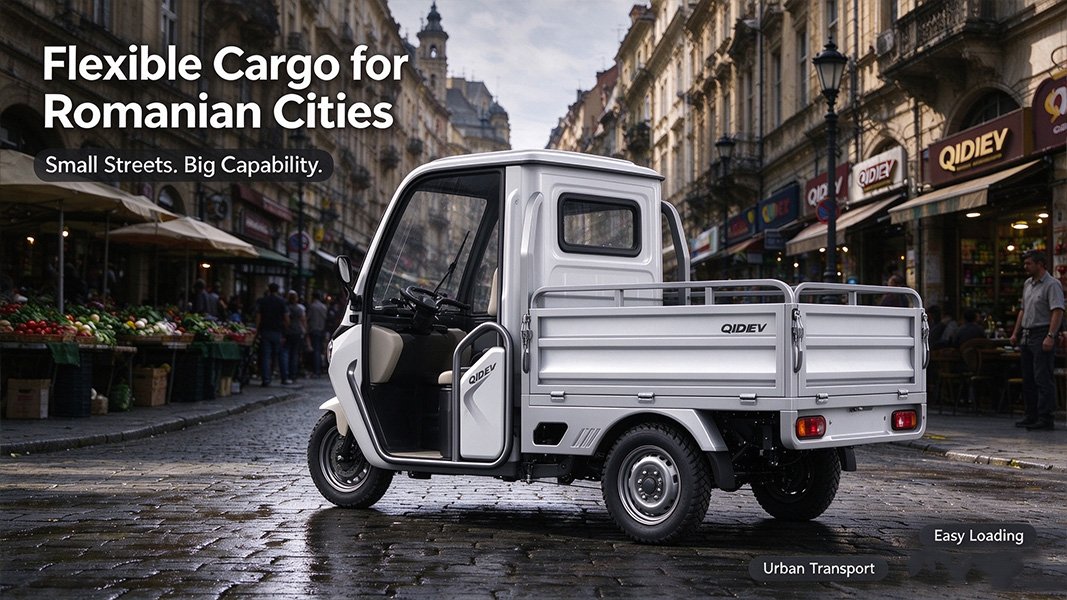
Cargo transportation
- Motor: 1500W
- Battery: 72V 58Ah
- Published range: 80–100 km
- Maximum speed: 45 km/h
- Cargo platform: approximately 1.6 metres
- Listed EXW price: US$1,180
- Listed approval category: EEC / L5e-B
Suitable for agricultural transportation, market deliveries, warehouse operations and local commercial logistics.
EasyGo – Electric Passenger Tuk-Tuk

Passenger transportation
- Motor: 4500W AC
- Battery: 72V 150Ah LiFePO₄
- Published range: 150 km
- Maximum speed: 60 km/h
- Seating configurations: 2, 4 or 6 seats, depending on configuration
- Listed price: US$2,830
- Product page: EEC / CoC information
Potential applications include urban passenger transportation, tourism, resorts and private transport services.
Land Cruiser R1 – Flatbed Electric Cargo Tricycle
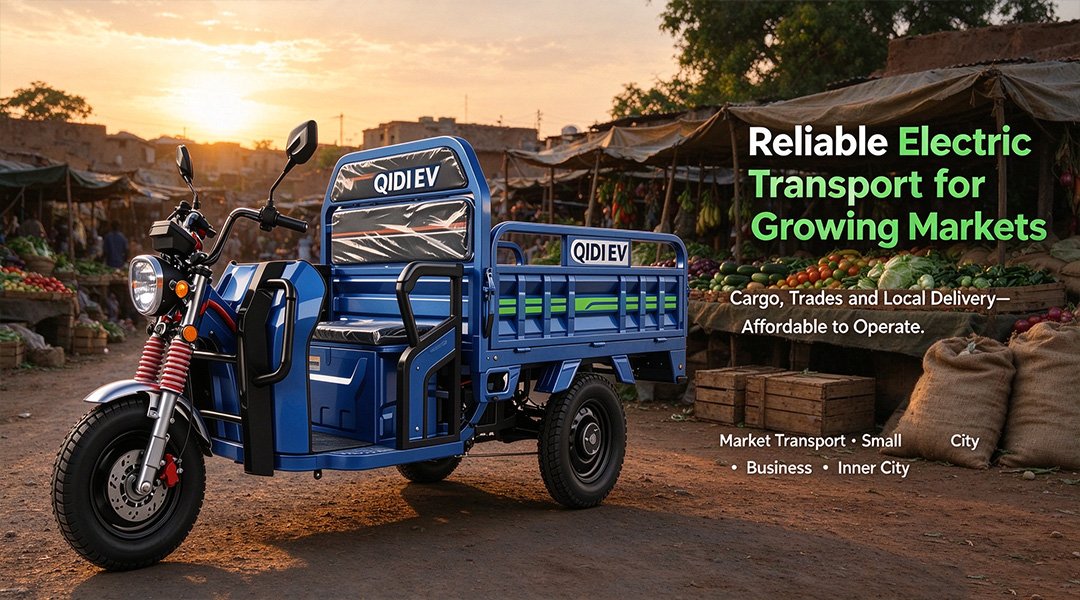
Flexible cargo loading
- Motor: 1500W
- Battery: 72V 58Ah lead-acid
- Published range: 60–80 km
- Maximum speed: 45 km/h
- Listed payload: 585 kg
- Open cargo platform: approximately 1.6 metres
- Listed EXW price: US$970
- Listed approval category: EEC / CoC / L2e-U
The open flatbed design is suitable for irregularly shaped goods, agricultural products, equipment and materials transportation.
Aurora A8 – Electric Recreational Tricycle
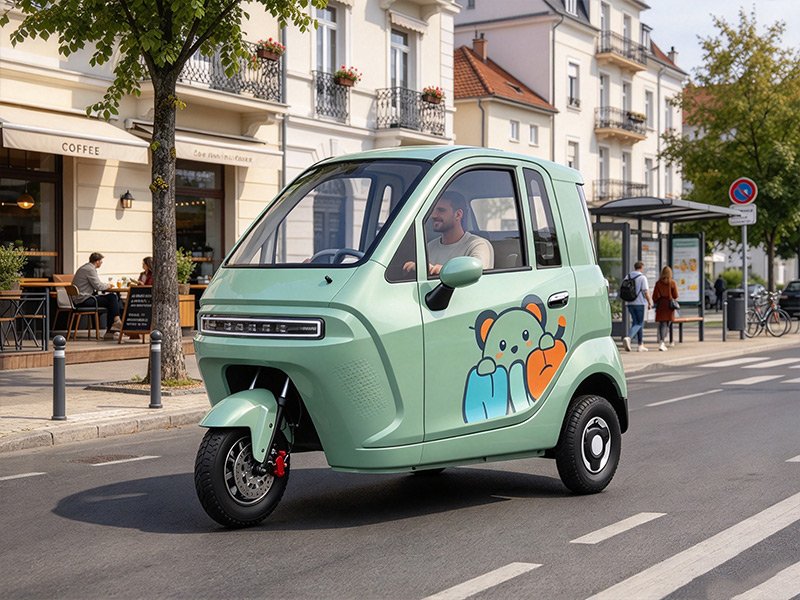
Personal and leisure mobility
- Motor: 60V 1500W AC
- Battery: 60V 80Ah
- Published range: at least 90 km
- Maximum speed: 45 km/h
- Listed price: US$2,400
- Product page: EEC / CoC ready, with approval availability subject to the selected unit
Potential applications include private communities, resorts, leisure facilities and local personal transportation.
5. QIDI Electric Four-Wheeler Products for Commercial and Utility Applications
Electric four-wheel vehicles are an important extension of the compact electric transportation market.
Compared with traditional cargo tricycles, they can offer different body structures, cargo protection and working capabilities.
NIO A8H – L7e Electric Utility Pickup
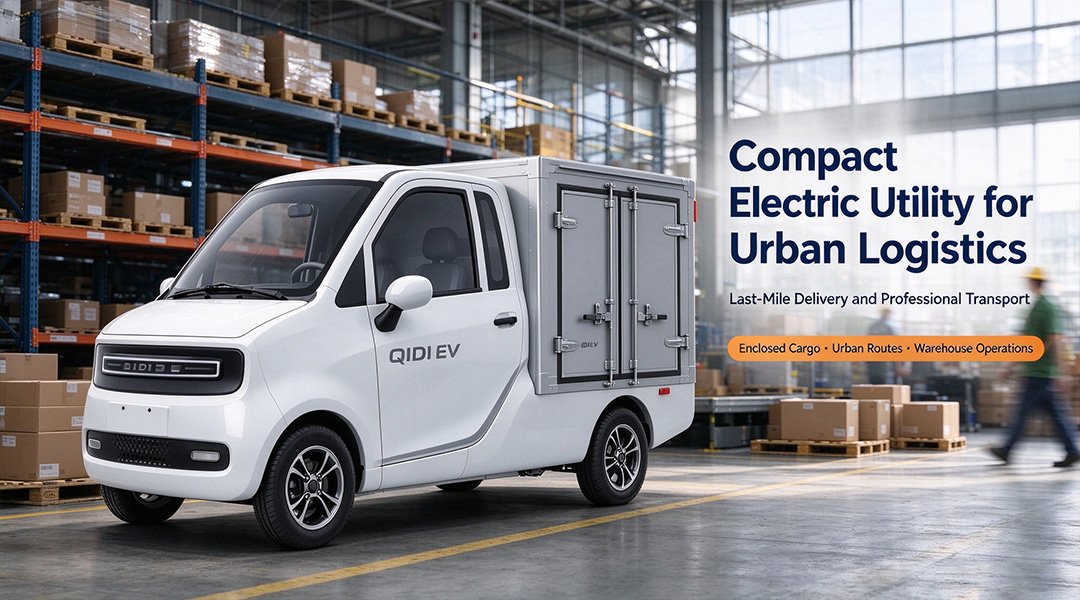
- Motor: 5000W
- Battery: 72V 120Ah
- Published range: at least 90 km
- Maximum speed: 52 km/h
- Listed payload: 1,183 kg
- Approval listed: EEC / CoC / L7e-CU
- Listed price: US$4,230
Suitable for professional local logistics, industrial sites, warehouses and utility transportation.
NIO Mini – Compact Electric Pickup
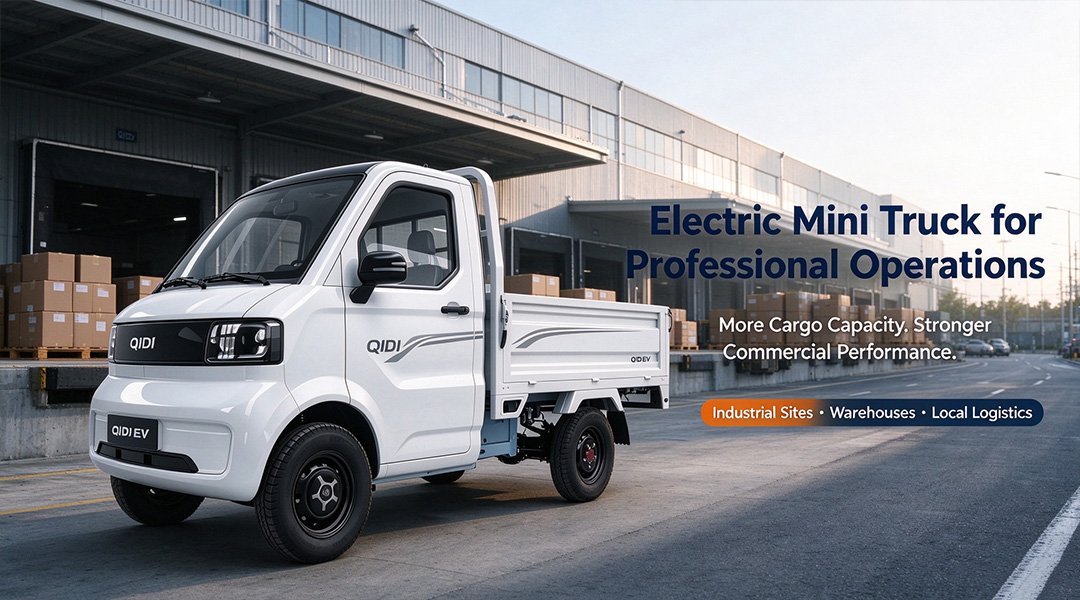
- Motor: 4000W
- Battery: 72V 100Ah
- Published range: 100 km
- Maximum speed: 55 km/h
- Approval listed: EEC / CoC / L7e-CU
- Listed price: US$2,820
A compact option for local delivery, property maintenance and small-business transportation.
TANK 90 – Electric Farm Pickup

- Motor: 1500W
- Battery: 60V 80Ah lithium-ion
- Published range: 40–80 km
- Maximum speed: 30 km/h
- Listed payload: 300 kg
- Product page: ECE / CoC information
Designed for farms, orchards, gardens and private estates. Its exact approval category should be confirmed from the certificate for the selected vehicle.
Aurora A9 – Enclosed Electric Vehicle

- Motor: 3000W
- Battery: 72V 100Ah
- Approval listed: EEC / CoC / L7e-CP
- Listed price: US$3,220
Suitable for customers looking for enclosed electric mobility for local transportation and private property use.
Important: All product specifications and prices above are based on QIDI’s published product pages. Actual supply configurations, approval documents, battery options and prices should be confirmed before ordering. A product category page or marketing description does not replace the individual vehicle’s type-approval certificate.
6. Electric Vehicle Import Tariffs: HS Codes for Complete Vehicles and Parts
Import duty is one of the most important considerations for international distributors.
However, there is no single global tariff rate for electric three-wheelers or four-wheelers. Customs classification depends on the vehicle’s construction, intended use, technical characteristics and the tariff schedule of the importing country.
The following HS codes are useful starting points under the international HS 2022 framework.
| Product type | Potential HS code | General description |
|---|---|---|
| Electric passenger vehicles | 8703.80 | Motor cars and other vehicles principally designed for passenger transport, with only an electric motor |
| Electric cargo vehicles | 8704.60 | Motor vehicles for the transport of goods, with only an electric motor |
| Electric motorcycles and certain three-wheelers | 8711.60 | Motorcycles, including mopeds, with electric propulsion |
| Motor vehicle parts | 8708 | Parts and accessories of vehicles under headings 8701–8705 |
| Motorcycle and related vehicle parts | 8714 | Parts and accessories of vehicles under headings 8711–8713 |
| Lithium-ion batteries | 8507.60 | Lithium-ion accumulators |
| Electric motors | 8501 | Electric motors and generators |
| Electrical control equipment | 8537 | Boards, panels and other bases equipped with electrical control apparatus |
Important classification point: A three-wheel vehicle is not automatically classified under 8711 simply because it has three wheels. A cargo vehicle designed principally for transporting goods may be considered under heading 8704, while certain motorcycle-type passenger or utility tricycles may fall under 8711. The customs authority makes the final decision based on the actual vehicle.
Regional Import Tariff Reference Table
The following table provides verified tariff examples and classification guidance for major importing regions. The rates are reference points, not universal regional rates. They mainly illustrate standard or MFN treatment; preferential agreements, origin rules and additional trade measures can change the final amount.
| Region | Representative market | Complete electric cargo vehicle | Electric motorcycle-type vehicle | Parts / SKD consideration |
|---|---|---|---|---|
| North America | United States | 8704.60: 25% general base rate | 8711.60: Free general base rate | 8708 / 8714 rates depend on the exact part; additional origin-based measures may apply |
| Canada | 8704.60: 6.1% MFN reference | Check the exact 8711 tariff line | 8708 / 8714 parts have individual tariff lines and preferential treatments | |
| European Union | EU Member States | 8704.60: 10% third-country reference | Check the applicable 8711.60 TARIC line | 8708 / 8714 and battery 8507.60 have separate tariff measures |
| Africa | East African Community | EAC CET uses 0%, 10%, 25% and 35% tariff bands; exact vehicle line must be checked | Country and tariff-line confirmation required | Genuine parts may receive different treatment from finished vehicles |
| Nigeria / ECOWAS | Check the current ECOWAS CET and Nigeria’s 2026 tariff amendments | Exact national tariff line required | National adjustments and import policy measures may apply | |
| Southeast Asia | Indonesia | Check BTKI 2022 and the applicable MFN or ASEAN-China preferential rate | Check the exact 8711.60 national tariff line | Separate components may have different BTKI rates and import controls |
| Thailand / Vietnam | National tariff schedules and applicable trade agreements determine the rate | Exact national tariff line required | FTA origin rules and local EV policies may affect duty | |
| South Asia | India | 8704.60: 40% standard tariff reference | 8711.60: 100% standard tariff reference | Parts have separate rates; exemptions and notifications can change effective duty |
| Central Asia | Kazakhstan / EAEU | EAEU Common Customs Tariff applies; exact subheading and current measures must be checked | Check the relevant 8711.60 line | Genuine parts and complete SKD kits must be classified separately according to customs rules |
What Do These Tariff Examples Mean for Importers?
Several examples are particularly important:
- United States: The 2026 US tariff schedule lists a 25% general duty rate for HS 8704.60 electric goods vehicles, while HS 8711.60 has a free general base rate. However, the origin of the vehicle can trigger additional trade measures, and the final duty may be considerably higher than the base rate.
- European Union: The third-country tariff reference for HS 8704.60 is 10%. The exact treatment of passenger tricycles, motorcycle-type vehicles and parts should be checked separately in TARIC.
- Canada: The 2026 Canadian tariff schedule lists a 6.1% MFN reference rate for HS 8704.60. Preferential rates may apply to eligible origins under trade agreements.
- India: The standard tariff reference for HS 8704.60 is 40%, while HS 8711.60 is listed at 100%. Actual payable duty must be checked against the applicable exemption notifications, surcharges and other import taxes.
- East Africa: The EAC Common External Tariff uses four general tariff bands: 0%, 10%, 25% and 35%. The applicable vehicle rate must be identified from the precise national tariff line rather than assuming every electric vehicle is charged at the same rate.
For importers, customs duty is only one part of landed cost. VAT, sales tax, port charges, customs clearance, inland transportation and other import measures must also be considered.
7. CBU vs. SKD: Can Importing Vehicle Parts Reduce Customs Duty?
Some distributors consider importing vehicles in SKD or CKD form instead of importing fully assembled vehicles.
This can offer logistical advantages, including more efficient container loading and opportunities for local assembly. However, SKD does not automatically mean a lower customs duty rate.
Under the World Customs Organization’s General Interpretative Rule 2(a), an incomplete or unassembled article can be classified as the complete article if, as presented, it has the essential character of that complete article.
For example, a complete vehicle supplied as a disassembled kit may still be classified as a complete vehicle rather than as separate parts.
A genuinely separate shipment of individual components may be classified under different headings, such as 8708, 8714, 8507 or 8501, depending on the actual goods.
Before arranging SKD imports, distributors should confirm:
- Whether the kit is treated as an unassembled complete vehicle.
- Whether local assembly is permitted.
- Whether local manufacturing or assembly registration is required.
- Whether the imported components need separate safety or conformity documents.
- Whether the country offers a preferential tariff scheme for qualifying local assembly.
The correct approach is to calculate the total landed cost under both CBU and SKD arrangements—not simply compare the headline customs duty.
8. What Are the Advantages of E-mark and CoC Certification?
For customers importing electric three-wheelers and four-wheelers into Europe, vehicle approval is a major purchasing consideration.
E-mark approvals are associated with applicable UNECE regulations, while EU whole-vehicle type approval and the Certificate of Conformity (CoC) operate within the relevant EU legal framework.
A valid CoC confirms that an individual vehicle conforms to its approved vehicle type.
For European distributors, appropriate approval documentation can provide several advantages:
- Easier registration process: A vehicle with valid EU type approval and a matching CoC has an important legal basis for registration in EU Member States.
- Greater buyer confidence: Customers can check the approved vehicle category, technical characteristics and relevant approval documentation.
- Clearer product positioning: L2e, L5e and L7e vehicles belong to different regulatory categories. Proper documentation helps distributors explain the vehicle’s intended use.
- Better market access: Approved vehicles can be more attractive to professional distributors and customers who require road-legal transportation.
- Lower compliance uncertainty: Verifiable approval documents reduce the risk of purchasing a vehicle that cannot meet the destination market’s requirements.
However, E-mark, EU type approval and CoC are not interchangeable terms. A CoC does not automatically prove that every component or configuration is approved, and an approval for one model does not automatically cover a different model or variant.
Furthermore, EU approval does not automatically replace the separate requirements of the United States, Africa, Southeast Asia or other non-EU markets.
9. The Future of Electric Three-Wheelers and Four-Wheelers
The next stage of market development will likely be driven by five trends.
1. Better battery technology
Lithium-ion and LFP batteries are becoming increasingly important because customers want longer operating ranges, lower vehicle weight and better charging efficiency.
2. More specialized vehicle designs
Instead of one vehicle serving every purpose, manufacturers will develop more specific cargo, passenger, agricultural, recreational and industrial models.
3. Growing demand for affordable commercial electrification
Small businesses and independent operators need affordable electric vehicles, not necessarily expensive passenger EVs.
4. Stronger certification requirements
As electric vehicle markets mature, importers will increasingly focus on vehicle approval, battery safety, documentation and local registration.
5. Expansion beyond major EV markets
India and China remain central to electric three-wheeler sales, but new opportunities may emerge in Africa, Central Asia, Southeast Asia and selected European utility vehicle markets.
The future is not simply about replacing every petrol vehicle with an electric car. It is also about finding smaller, more economical vehicles that perform specific transportation tasks efficiently.
10. Frequently Asked Questions
Q1: Why are electric three-wheelers more popular in some countries than electric cars?
They generally have a lower purchase price, are suitable for short-distance transportation and can carry passengers or goods. For many small businesses, they provide a more affordable entry into electric mobility.
Q2: Are electric cargo tricycles suitable for international markets?
Yes, but buyers should check local vehicle classification, maximum payload, road-use restrictions, battery requirements and registration procedures.
Q3: What is the difference between an electric three-wheeler and an L7e electric four-wheeler?
They belong to different vehicle categories. Three-wheelers may fall under L2e or L5e depending on their design and specifications. L7e applies to heavy quadricycles. Their approval requirements and permitted characteristics are different.
Q4: Does an E-mark or CoC certificate mean a vehicle can be imported anywhere in the world?
No. These documents can provide significant advantages in the applicable European and UNECE regulatory frameworks, but other countries may require additional local approvals, testing or registration procedures.
Q5: Is importing SKD vehicles always cheaper than importing complete vehicles?
No. SKD may improve container utilization and support local assembly, but customs can classify certain unassembled kits as complete vehicles. The total landed cost and local compliance requirements must be calculated first.
Q6: Which HS code should be used for an electric cargo tricycle?
There is no single code for every electric tricycle. Depending on its construction and intended use, it may fall under 8704.60 or 8711.60. The importing country’s customs authority makes the final classification.
Conclusion: Electric Three-Wheelers Are Creating New Opportunities in Global Transportation
Electric three-wheelers are becoming popular because they solve practical transportation problems at an affordable price. Their flexibility makes them useful for passenger services, agriculture, local delivery, market transportation and small businesses.
At the same time, electric four-wheel utility vehicles are expanding the available options for professional transportation, warehouses, farms and industrial operations.
For importers and distributors, the best opportunity is to select the right vehicle for the target market, understand its customs classification, calculate the total landed cost and confirm the relevant approval documents.
With electric cargo tricycles, passenger tuk-tuks, recreational tricycles and L7e utility pickups, QIDI offers different solutions for customers looking to participate in the global electric mobility market.
Looking for an electric three-wheeler or electric four-wheeler supplier? Contact QIDI to discuss product specifications, E-mark/CoC documentation, CBU or SKD supply and international shipping solutions.