
Southeast Asia Electric Vehicle Market: E-Tricycles, Golf Carts & Farm UTV Import Guide
Southeast Asia Electric Vehicle Market Guide: Electric Tricycles, Golf Carts, Farm UTVs and Import Certification
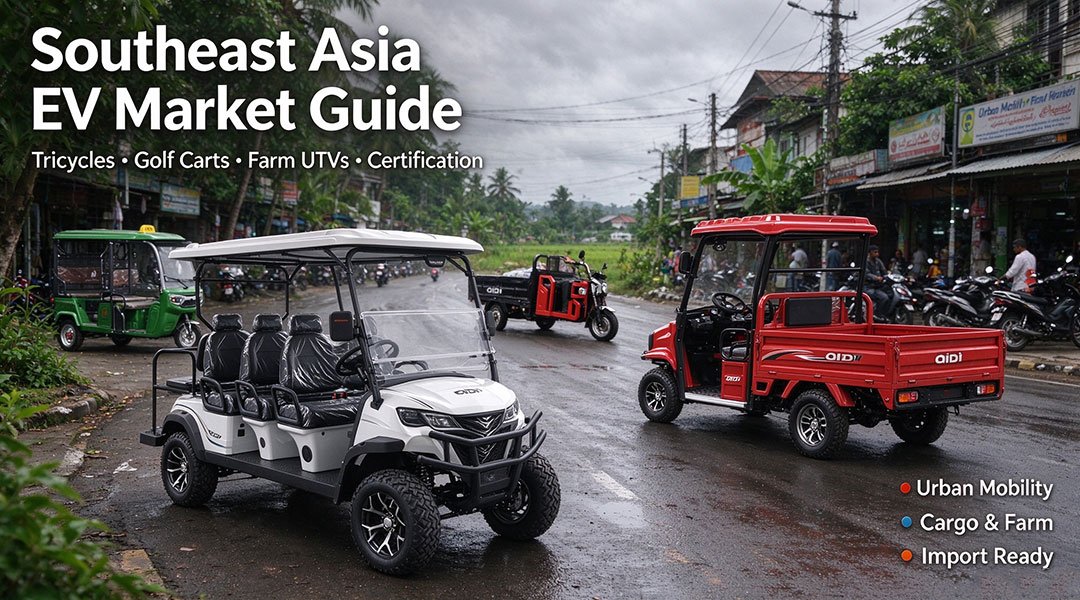
1. Why Southeast Asia Is Becoming an Important Market for Electric Utility Vehicles
Southeast Asia is an attractive market for practical electric vehicles because of its combination of expanding cities, tourism development, agricultural activity and growing demand for affordable commercial transportation.
Unlike markets where electric vehicles are purchased mainly for private commuting, many Southeast Asian buyers evaluate electric vehicles according to their ability to generate income or reduce operating costs.
Three segments deserve particular attention:
- Electric cargo and passenger tricycles: Used for local delivery, market transportation, passenger shuttles and small businesses.
- Electric golf carts and sightseeing vehicles: Increasingly relevant to resorts, golf courses, hotels, tourist attractions, campuses and gated communities.
- Electric farm UTVs and four-wheel utility vehicles: Designed for farms, plantations, orchards, construction sites and industrial facilities.
The opportunity is not identical in every country. The Philippines has an established three-wheel passenger transport culture. Indonesia offers opportunities in agricultural logistics and local delivery. Thailand has a strong tourism and resort market. Vietnam and Malaysia also offer opportunities for electric utility vehicles, particularly in controlled commercial environments.
For importers, the key question is not simply which vehicle is cheapest. It is whether the vehicle’s design, certification, performance and intended use match local regulations.
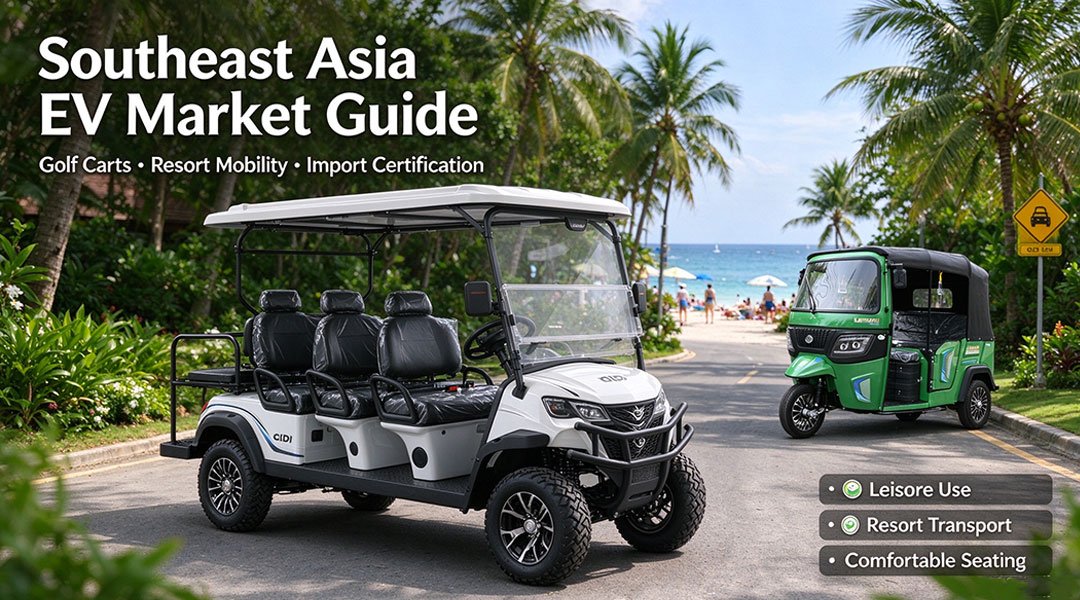
2. Market Opportunities by Vehicle Category
Electric Tricycles: Commercial Transportation and Last-Mile Delivery
Electric tricycles are attractive because they combine a relatively compact body with practical carrying capacity. They can operate in narrow streets, markets, farms and industrial areas where conventional trucks may be inconvenient.
Potential applications include:
- Last-mile parcel and food delivery
- Passenger transportation and local shuttle services
- Agricultural product transportation
- Construction materials and equipment delivery
- Waste collection and warehouse logistics
The Philippines is particularly familiar with three-wheel passenger transportation. In Indonesia, cargo-oriented models can serve farms, markets and small logistics operators. In Thailand and Vietnam, passenger shuttles and commercial delivery vehicles may be suitable for selected routes and private facilities.
Electric Golf Carts: Tourism, Resorts and Property Management
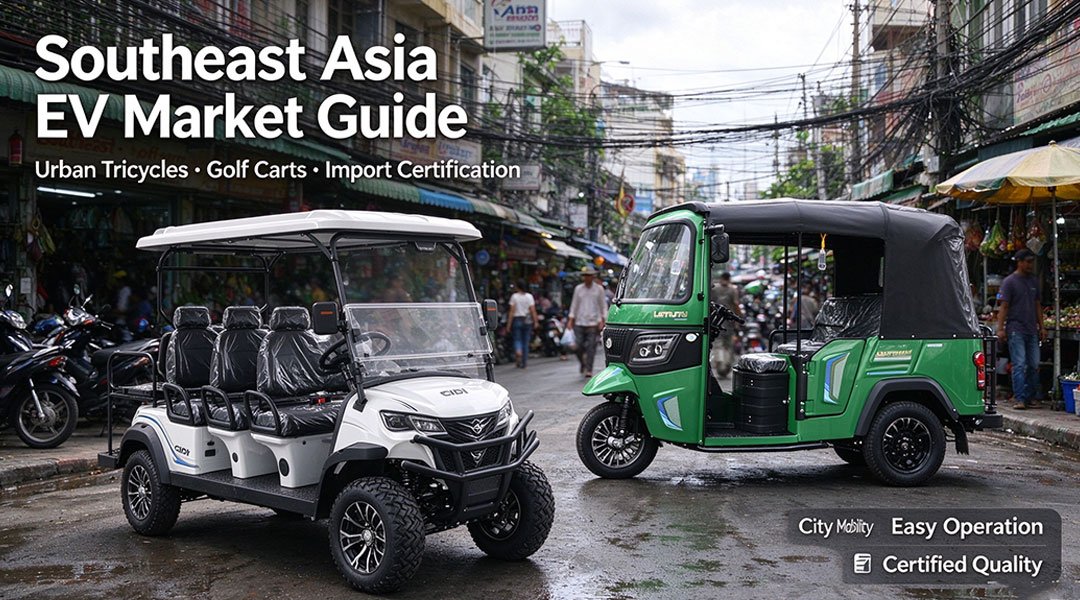
The Southeast Asian tourism industry creates a different opportunity.
Hotels, golf courses, island resorts, theme parks, residential communities and industrial campuses need quiet vehicles that can transport visitors, staff and equipment over short distances.
Electric golf carts offer several practical advantages:
- Low noise for hotels and residential areas
- No local exhaust emissions during operation
- Lower routine energy costs than comparable fuel-powered vehicles
- Flexible seating configurations
- Convenient operation on private roads and designated routes
However, a golf cart designed for private property is not automatically approved for public-road use. Importers should confirm whether the intended vehicle is classified as a golf cart, low-speed vehicle, passenger vehicle or another category under local regulations.
Electric Farm UTVs: Agriculture and Industrial Utility
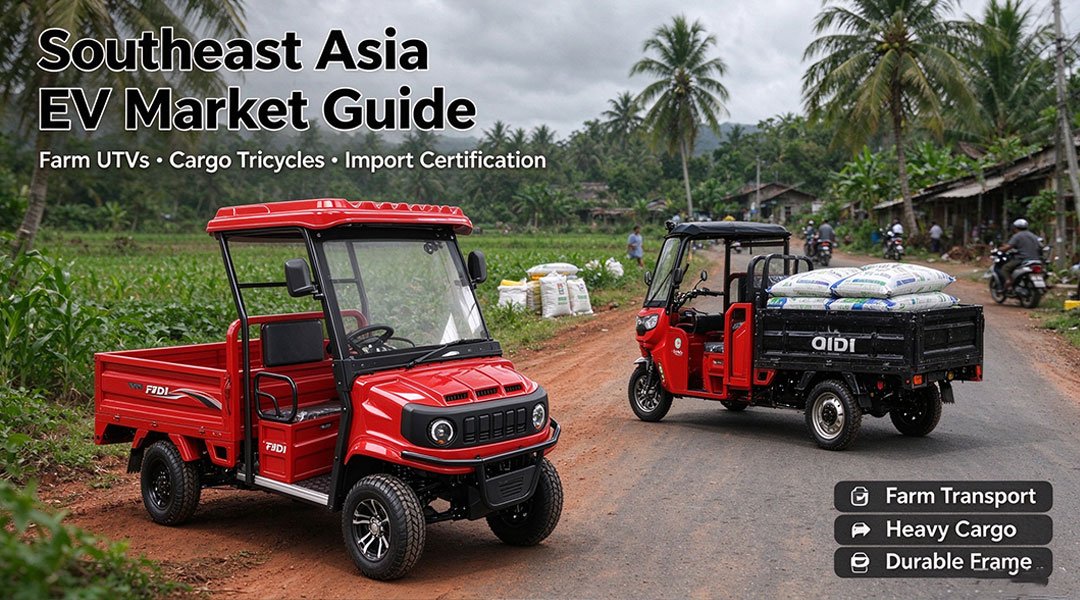
Electric farm UTVs are designed for work rather than conventional passenger commuting.
Typical applications include:
- Moving fertilizers, tools and agricultural products
- Transporting staff around plantations
- Orchard and greenhouse operations
- Resort maintenance and security patrols
- Light industrial and construction-site transportation
For buyers, important selection criteria include rated payload, ground clearance, gradeability, suspension, braking performance, battery capacity and water protection.
A vehicle that performs well on a smooth golf course may not be suitable for muddy plantation roads. Buyers should compare the actual operating environment before choosing a model.
3. Indicative Southeast Asian Electric Vehicle Price Ranges
Prices vary considerably according to battery chemistry, motor power, payload, passenger capacity, local taxes, dealer margins and certification requirements.
The following figures are useful market benchmarks rather than guaranteed transaction prices.
| Vehicle category | Indicative price reference | Main buying considerations |
|---|---|---|
| Basic electric tricycle | Around US$1,000–2,000 | Local delivery and light commercial use |
| Heavy-duty electric cargo tricycle | Around US$1,500–3,500+ | Payload, chassis strength and climbing ability |
| Enclosed passenger electric tricycle | Around US$2,000–4,000+ | Seating, cabin, battery and road approval |
| Electric golf cart, 2–6 seats | Around US$3,000–7,000+ at factory/export level | Seating, battery, range and resort requirements |
| Electric farm pickup / utility vehicle | Around US$1,700–4,000+ | Payload, ground clearance and suspension |
| Higher-power electric UTV | Around US$3,000–6,000+ | Motor output, off-road capability and battery capacity |
Local price examples: Publicly advertised Philippine electric tricycle prices range from approximately PHP 65,000 for some basic cargo models to PHP 200,000–330,000 for certain commercial passenger models. In Thailand, one local golf-cart supplier advertises 2-seat models from approximately THB 209,000 and larger configurations at higher prices.
These local retail prices should not be directly compared with factory EXW quotations. Retail prices may include local taxes, transportation, dealer margins, warranty support and registration-related costs.
QIDI Electric Vehicle Product Recommendations
QIDI offers several vehicle types that can be evaluated for different Southeast Asian applications.
| QIDI model | Vehicle type | Main application | Published price reference |
|---|---|---|---|
| Land Cruiser | Heavy-duty cargo tricycle | Farm logistics, construction and commercial hauling | Contact for quotation |
| Atlas T1 | Enclosed hydraulic dump tricycle | Heavy agricultural and industrial transport | Contact for quotation |
| Thunder SR1 | Semi-enclosed farm tricycle | Farms, markets and construction materials | Contact for quotation |
| EasyGo | Passenger electric tuk-tuk | Tourist shuttles and passenger services | US$2,830 |
| Tank 90 | Four-wheel farm pickup | Orchards, farms and estate transportation | US$1,790 EXW |
| Tank PRO | Four-wheel electric UTV | Sightseeing, off-road recreation and utility work | Contact for quotation |
| Tank PRO GC | Electric golf cart | Golf courses, hotels and resorts | US$3,200–3,490 EXW |
| Aurora A9 | Enclosed four-wheel electric vehicle | Passenger and light utility transportation | US$3,220 |
A few specifications help explain the differences:
- Land Cruiser: The published product information highlights a 1,000 kg maximum payload, 80–100 km claimed range and 45 km/h maximum speed. It is aimed at demanding cargo applications.
- Atlas T1: A 5,000W enclosed agricultural tricycle with hydraulic dumping, a published 1,500 kg rated payload and 100–130 km claimed range.
- Thunder SR1: A semi-enclosed farm tricycle with a 1,800W motor, 1.8 m² cargo bed and 60–80 km claimed range.
- EasyGo: A passenger tuk-tuk with a 4,500W AC motor, 72V 150Ah LiFePO4 battery and a published 150 km range.
- Tank 90: A four-wheel farm pickup with a 300 kg payload, 40–80 km claimed range and four-wheel disc brakes.
- Tank PRO: A four-seat electric UTV with a 5,000W motor, 80–90 km claimed range and 30% published gradeability.
- Tank PRO GC: A 2/4/6-seat golf cart with a 3,500W motor and a published 80 km range.
- Aurora A9: An enclosed four-wheel vehicle with a 3,000W motor, 72V 100Ah battery and a published range of at least 90 km.
All stated range and performance figures are manufacturer-published specifications. Actual results depend on payload, road conditions, temperature, driving style and battery condition.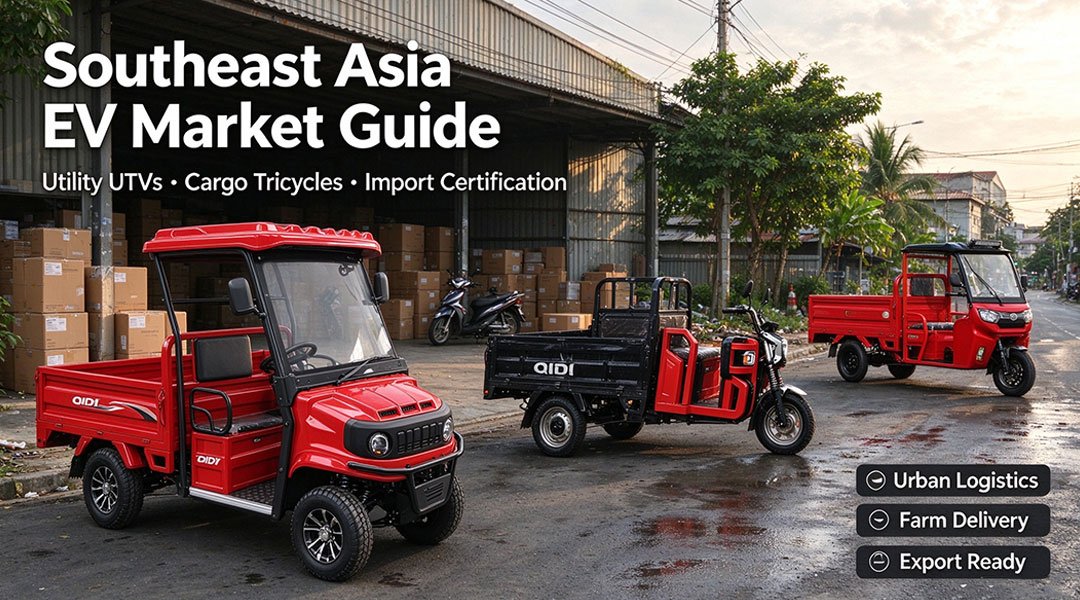
4. What Certifications Are Required to Import Electric Vehicles into Southeast Asia?
This is one of the most important questions for overseas distributors.
There is no single certificate that automatically allows an electric tricycle, golf cart or farm UTV to be imported, cleared and registered in every ASEAN country.
Requirements depend on the destination country, vehicle classification, intended use and whether the vehicle will operate on public roads or private property.
E-Mark and Certificate of Conformity (CoC)
For vehicles approved under applicable UN Economic Commission for Europe (UNECE) regulations, E-Mark type approval and the associated Certificate of Conformity can provide important technical evidence.
Potential advantages include:
- Recognized technical evidence: The approval demonstrates that specified vehicle components or systems have been tested against applicable UN regulations.
- Easier technical review: Local authorities and importers can use supporting approval documents when assessing vehicle compliance.
- More transparent specifications: The approved configuration, technical data and vehicle identification information can help reduce uncertainty during import and registration preparation.
- Better distributor confidence: Certified products can be easier to evaluate when building a formal dealership or fleet procurement business.
However, an E-Mark or European CoC does not automatically replace national import permits, local vehicle type approval, customs declarations or road registration in Southeast Asia.
A CoC is not a universal customs-clearance certificate. Importers must confirm which specific UN regulations and vehicle approval documents are relevant to their destination country.
Other Important Technical Documents
Depending on the vehicle and destination, importers may be asked to prepare:
- Vehicle type-approval certificate or local homologation documents
- Manufacturer’s Certificate of Conformity
- Vehicle technical specification sheet
- Chassis/VIN and motor identification information
- Battery technical data and safety test documents
- UN 38.3 lithium battery test summary, where applicable
- Battery transport documents and MSDS/SDS, where required
- UN R100 or other applicable electric powertrain safety evidence, depending on vehicle category and national rules
- Lighting, braking, electromagnetic compatibility and other relevant test reports
The exact document list should be confirmed before production and shipment.
5. Country-by-Country Import and Certification Overview
The following table summarizes important regulatory considerations in selected Southeast Asian markets. It is a practical starting point for distributors, not a substitute for a formal classification decision from the local authority.
| Country | Main authority / system | Important certification or approval considerations |
|---|---|---|
| Indonesia | Ministry of Transportation / Directorate General of Land Transportation | Vehicle type approval (SUT) and unit registration certificate (SRUT) may apply to road vehicles. Importer authorization and customs requirements must also be checked. |
| Thailand | Department of Land Transport (DLT) and Thai Customs | Confirm vehicle classification, registration eligibility and any applicable import permits or technical requirements. Private-property golf carts and public-road vehicles should be assessed separately. |
| Philippines | Land Transportation Office (LTO) and Bureau of Customs | Electric vehicle classification and registration requirements are governed by LTO rules. Commercial passenger use may involve additional operating and local franchise requirements. |
| Vietnam | Vietnam Register and relevant customs authorities | Imported vehicles may require technical safety and environmental quality inspection and certification. Four-wheel passenger vehicles have specific inspection procedures. |
| Malaysia | MITI, JPJ, Customs and relevant technical agencies | Approved Permit (AP) requirements can apply to imported CBU and CKD motor vehicles. Vehicle approval and battery import requirements should be checked separately. |
| Singapore | Land Transport Authority (LTA) and Singapore Customs | Road vehicles require the applicable LTA approval and registration process. Technical documents and EV safety evidence may be requested. |
Indonesia: SUT and SRUT
Indonesia has a formal vehicle type-testing and registration system.
- SUT (Sertifikat Uji Tipe): Type approval issued after the relevant vehicle type passes the required testing.
- SRUT (Sertifikat Registrasi Uji Tipe): A registration document issued for individual vehicles based on an approved type.
Importers should confirm whether the proposed vehicle requires local type testing and how the SUT/SRUT process applies to the specific vehicle category.
Do not assume that a European CoC automatically replaces Indonesian vehicle approval.
Thailand: Confirm the Vehicle’s Intended Use
Thailand has different practical considerations for road vehicles and vehicles operating only on private property.
A golf cart used inside a resort or golf course may have a different regulatory treatment from a passenger vehicle intended for public roads.
Before shipping, the importer should confirm the classification and registration position with the relevant Thai authorities. Customs documentation normally includes an import declaration, commercial invoice, packing list and bill of lading, together with any required permits and certificate of origin.
Philippines: LTO Classification and Registration
The Philippines has specific LTO guidelines for electric motor vehicle classification, registration and operation.
For vehicles intended for public-road use, importers should check the vehicle category, technical specifications, registration requirements and applicable operating restrictions.
Passenger transport businesses may also need to consider local franchise and operating permissions.
A vehicle that can be imported through customs is not necessarily approved to operate on every public road.
Vietnam: Imported Vehicle Quality Inspection
Vietnam has formal technical safety and environmental quality inspection procedures for imported motor vehicles.
The Vietnam Register publishes administrative procedures for imported vehicles, including four-wheel passenger vehicles. Importers should prepare the relevant inspection registration, import documents and manufacturer technical information before shipment.
The applicable procedure depends on the vehicle’s classification.
Malaysia: Approved Permit and Battery Requirements
Malaysia deserves particular attention for CBU and CKD vehicle imports.
MITI states that Approved Permit requirements cover motor vehicles and motorcycles imported as completely built-up and completely knocked-down vehicles.
There are also specific procedures for certain new reusable motor-vehicle batteries. From 1 January 2026, MITI’s published battery import procedure requires an AP for covered battery imports and lists supporting documents such as a Customs classification letter, product catalogue, invoice and Technical Evaluation Report. The report may include UN 38.3, UN R100 for four-wheel vehicles or UN R136 for two-wheel vehicles, as applicable, together with relevant IEC test reports.
Importers should confirm whether their vehicle shipment or separately imported traction batteries fall within the relevant requirements.
Singapore: LTA Approval and EV Technical Documents
Singapore has a detailed vehicle import and registration system.
LTA’s published guidance for imported goods vehicles includes manufacturer information, vehicle production and export information, technical component standards and EV powertrain test evidence, including relevant UN R100 documentation.
Importers should obtain confirmation from LTA before shipping a vehicle intended for road registration.
6. What Documents Are Normally Needed for Customs Clearance?
Although country-specific requirements differ, commercial shipments of electric tricycles, golf carts and farm utility vehicles commonly require the following documents:
| Document | Purpose |
|---|---|
| Commercial Invoice | Shows the seller, buyer, product description, quantity and transaction value |
| Packing List | Shows package quantity, dimensions, gross weight and net weight |
| Bill of Lading | Confirms the shipping arrangement and cargo details |
| Certificate of Origin (CO) | Identifies the country of origin and may support preferential tariff claims |
| Import Declaration | Submitted by the local importer or customs broker |
| Import Permit / AP | Required where the product or vehicle category is controlled |
| Vehicle Specification Sheet | Provides dimensions, motor power, battery capacity, speed, payload and other technical details |
| E-Mark / CoC / Type Approval Documents | Supports the technical compliance review where applicable |
| Battery Documents | May include UN 38.3, SDS/MSDS and transport-related information |
| Insurance Documents | Required where applicable under the shipping and import arrangement |
A Practical Import Process
A typical import project can be organized into six stages:
- Confirm the vehicle category. Decide whether the vehicle is a road-going passenger vehicle, cargo vehicle, golf cart or off-road UTV.
- Check local approval requirements. Confirm whether type approval, an import permit or other technical certification is required.
- Review the technical documents. Match the actual motor, battery, brakes, dimensions and vehicle configuration to the approval documents.
- Confirm the HS code and taxes. Have the local customs broker check the correct tariff classification, customs duty, VAT/GST and other applicable charges.
- Prepare the shipping documents. Finalize the invoice, packing list, bill of lading, certificate of origin and required permits.
- Complete customs clearance and registration. After customs release, complete any required vehicle inspection, registration and operating authorization.
Important: SKD or CKD packing does not automatically mean that a vehicle will be classified as ordinary spare parts. Customs authorities may consider whether the imported kit has the essential character of a complete vehicle. Confirm the classification before shipment.
7. Common Questions from Southeast Asian Electric Vehicle Importers
Q1: Can I import an electric golf cart without road-vehicle registration?
Possibly, if it is genuinely intended for private-property use and local rules allow that category. However, the importer should confirm the applicable classification and restrictions before ordering. A golf cart used on public roads may require a different approval and registration process.
Q2: Is E-Mark or CoC enough for customs clearance?
No. E-Mark and CoC documents can support technical compliance assessment, but they do not replace the commercial invoice, packing list, bill of lading, import declaration, required permits or national approval procedures.
Q3: Can I change the battery, motor or vehicle configuration after receiving certification?
Not without checking the approval conditions. Changes to the motor, battery, controller, braking system, dimensions, weight or other approval-relevant components may affect the validity of the original approval or require reassessment.
For certified vehicles, importers should confirm permitted customization before production. Cosmetic changes may be possible when they do not affect approved characteristics.
Q4: Should I import complete vehicles or SKD units?
Complete vehicles are convenient for buyers who want to begin operating quickly. SKD shipments may improve container utilization and support local assembly or distribution, but they require appropriate technical documentation, local assembly capability and confirmation of the customs classification.
The best option depends on the destination country’s import rules, labor costs, shipping costs and after-sales strategy.
Q5: Which battery is better for Southeast Asian conditions?
LiFePO4 batteries are attractive for commercial fleets because of their cycle life and thermal stability characteristics. Lead-acid batteries may offer a lower initial purchase price, but buyers should compare replacement frequency, charging time, usable capacity and total operating cost.
For hot and humid environments, battery protection, waterproofing, charging safety and after-sales service deserve particular attention.
Q6: What should distributors check before placing a bulk order?
At minimum, request:
- Full vehicle specifications and actual configuration
- Certification copies and applicable approval numbers
- Battery test and transport documents
- Spare-parts list and warranty terms
- Sample vehicle or pre-shipment inspection arrangements
- Container loading plan and packaging dimensions
- Written confirmation of the vehicle’s intended-use classification
8. How QIDI Supports Southeast Asian Electric Vehicle Buyers
Choosing an electric vehicle supplier should involve more than comparing the initial unit price.
QIDI provides several vehicle categories for different commercial applications, including heavy-duty electric cargo tricycles, passenger tuk-tuks, agricultural vehicles, electric UTVs and golf carts.
For Southeast Asian distributors and project buyers, the most practical approach is to select the vehicle according to its operating environment:
- For cargo delivery and difficult roads: Land Cruiser and Thunder SR1.
- For heavy agricultural transportation: Atlas T1 with hydraulic dumping.
- For passenger shuttles and tourism: EasyGo.
- For farm and estate transportation: Tank 90 and Tank PRO.
- For golf courses, hotels and resorts: Tank PRO GC.
- For enclosed passenger and utility applications: Aurora A9.
QIDI can provide product specifications and available certification documents for customers to review with their local importers and customs brokers before placing an order.
The final vehicle configuration and documentation should always be confirmed against the destination country’s regulations.
Conclusion: Choose the Right Electric Vehicle Before You Import
Southeast Asia offers opportunities across electric cargo tricycles, passenger tuk-tuks, golf carts and electric farm UTVs. However, each segment has different customers, operating conditions and regulatory requirements.
For importers, a successful purchase starts with three decisions:
- Choose a vehicle that matches the real operating environment.
- Confirm local certification, import permits and customs classification before shipment.
- Compare the total landed cost and long-term operating cost, not only the factory price.
With the right product selection and proper compliance preparation, electric utility vehicles can become a practical investment for Southeast Asian distributors, agricultural businesses, resorts and commercial fleets.
Looking for electric tricycles, golf carts or electric farm UTVs for your Southeast Asian market? Contact QIDI to request product specifications, certification documents and a quotation for your target country.