
Romania Electric Cargo Tricycle & Mini Truck Market: QIDI Models Compared
Romania’s Electric Cargo Tricycle and Mini Truck Market: Which QIDI Model Is Right for Your Business?
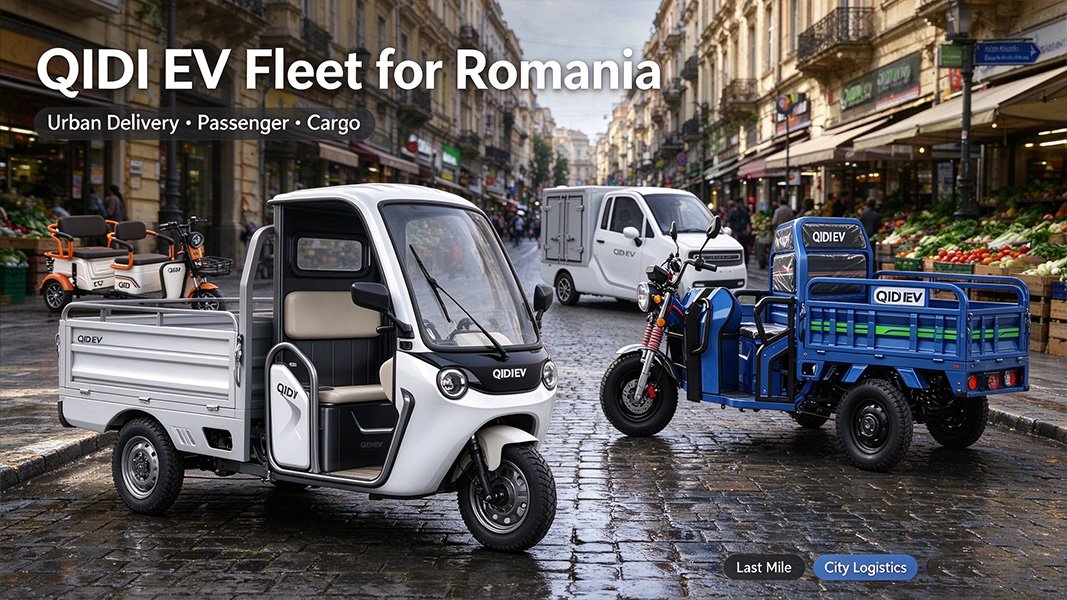
Romania is an emerging market for affordable electric commercial vehicles. From small farms and warehouses to local delivery businesses and private estates, more customers are looking for practical alternatives to conventional fuel-powered vehicles.
However, not every customer needs a full-size electric van or truck. Many Romanian businesses need something smaller, less expensive and easier to operate for short-distance transportation.
This creates opportunities for electric cargo tricycles, electric mini trucks, L7e electric pickups and electric mobility scooters.
In this guide, we compare four QIDI models and examine their potential applications, local market prices, import considerations and business value in Romania.
1. Romania’s Electric Vehicle Market: What Do the Numbers Tell Us?
According to the European Alternative Fuels Observatory (EAFO), Romania registered 651 new electric light commercial vehicles in 2025, compared with 552 in 2024, an increase of approximately 18%.
The wider electric vehicle market developed differently: new battery-electric passenger car registrations fell from 9,712 in 2024 to 8,833 in 2025. This suggests that Romanian buyers remain sensitive to vehicle affordability and practical value.
Charging infrastructure also expanded. Romania increased its reported public charging points from 2,660 AC and 1,906 DC points at the end of 2024 to 3,576 AC and 3,536 DC points in 2025.
For electric mini trucks and cargo tricycles, this market environment creates an interesting opportunity. Many compact commercial vehicles can be charged overnight using suitable AC charging equipment, without depending on public fast-charging stations.
It is important to note that official Romanian statistics do not separately report all L2e cargo tricycles, L5e utility tricycles and L7e electric pickups. The growth of electric vans is therefore a useful market indicator, not a direct sales forecast for these smaller vehicle categories.
2. Four QIDI Models for Different Romanian Customer Needs
The best vehicle depends on what the customer transports, how frequently it operates and where it will be driven.
1. Land Cruiser B10 – Electric Cargo Tricycle for Local Goods Transportation
Product: Land Cruiser B10 Electric Cargo Tricycle
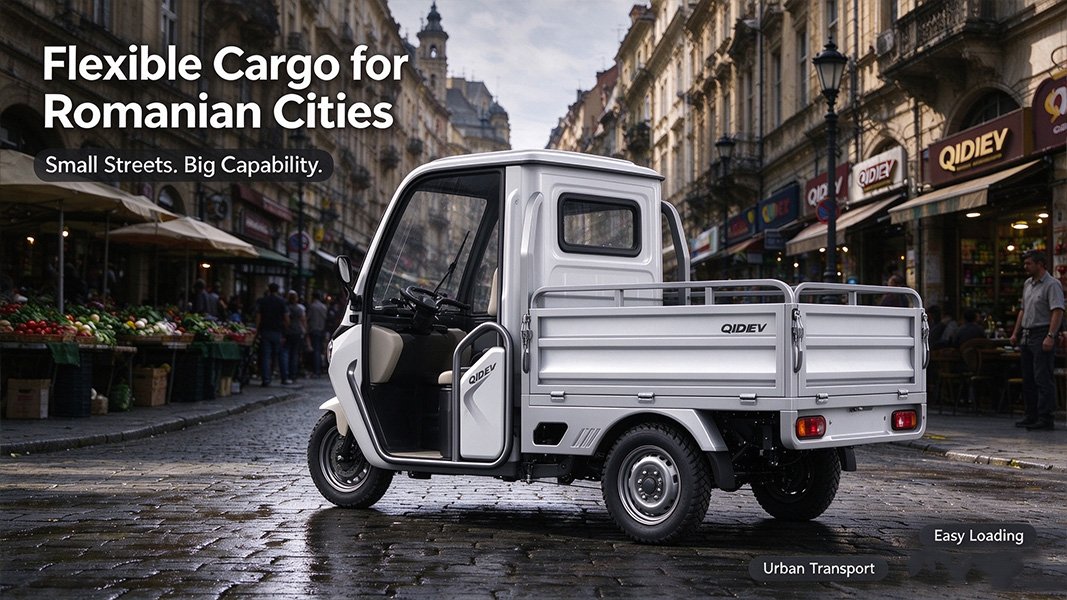
The Land Cruiser B10 is a three-wheel electric cargo vehicle with a 1.6-metre cargo platform. It is designed for practical goods transportation rather than passenger mobility.
Potential Romanian customers include:
- Small farms and agricultural businesses
- Market vendors and local wholesalers
- Warehouses and workshops
- Small construction and maintenance businesses
- Local delivery operators
Customer problem: A conventional van can be unnecessarily expensive for moving small loads around a farm, market or business property. A cargo tricycle provides a more compact alternative for short-distance work.
Why consider B10? Its cargo-oriented design is suitable for customers who prioritize loading space and affordable local transportation.
2. NIO A8H – L7e Electric Pickup for Professional Utility Work
Product: NIO A8H Electric Pickup – L7e-CU
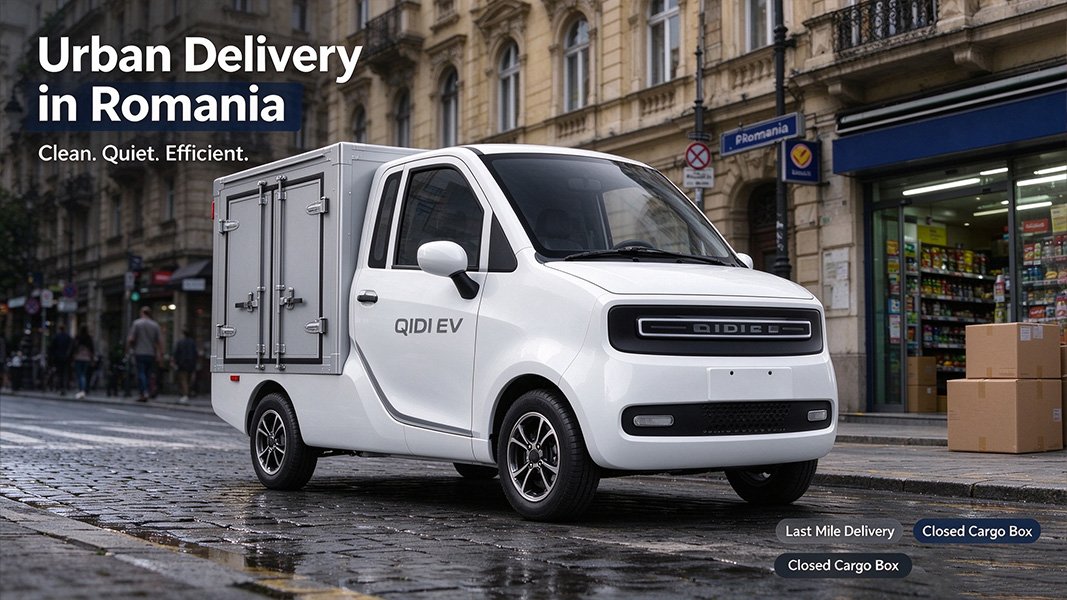
The NIO A8H is a four-wheel electric pickup designed for more demanding commercial applications.
Published specifications include:
- Motor: 72V 5000W
- Battery: 72V 120Ah
- Published range: at least 90 km
- Maximum speed: 52 km/h
- Listed payload capacity: 1,183 kg
- Vehicle category: L7e-CU
- Listed price: US$4,230
- Packing reference: 4 SKD units per 40HQ container
Customer problem: Some businesses need more cargo protection, a more substantial vehicle structure and higher transport capacity than a basic three-wheel cargo tricycle can provide.
Why consider NIO A8H? Its four-wheel configuration, enclosed cargo body and L7e-CU approval positioning make it a candidate for industrial estates, professional local logistics, property maintenance and commercial transportation.
The stated 1,183 kg payload should be checked against the official type-approval documentation and the vehicle’s permitted maximum mass before customers rely on it for road use.
3. Joyride P100 – Electric Mobility and Leisure Tricycle
Product: Joyride P100 Electric Mobility Scooter
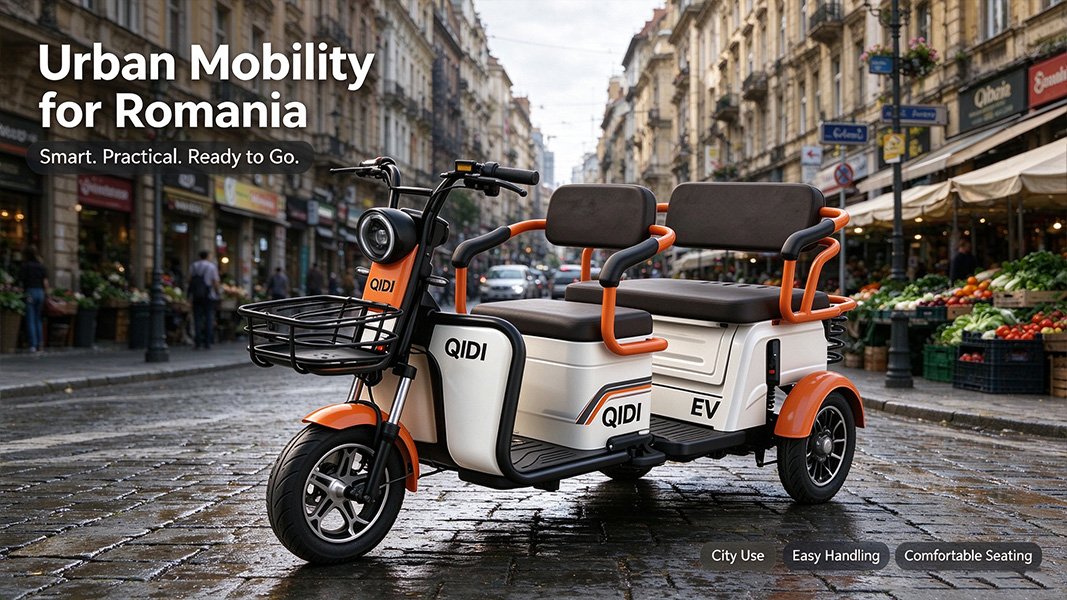
Joyride P100 is a passenger-oriented electric mobility and leisure tricycle rather than a cargo vehicle.
The QIDI L2e/L5e product range lists the JoyRide P100 as an L2e mobility model, with a 60V 1000W power system, a maximum speed of 25 km/h and a listed price of US$660.
Potential customer groups include:
- Private users seeking convenient local mobility
- Leisure and recreational facilities
- Resorts and tourist properties
- Large residential communities
- Private estates and controlled-access areas
Customer problem: Some users need convenient short-distance mobility without purchasing a conventional passenger car.
Why consider Joyride P100? Its three-wheel design and low-speed positioning make it suitable for leisure and local mobility applications. Buyers should confirm the approved seating configuration, intended road use and driver requirements before selecting it for public-road operation.
4. Land Cruiser R1 – Flatbed Electric Cargo Tricycle
Product: Land Cruiser R1 Electric Cargo Tricycle
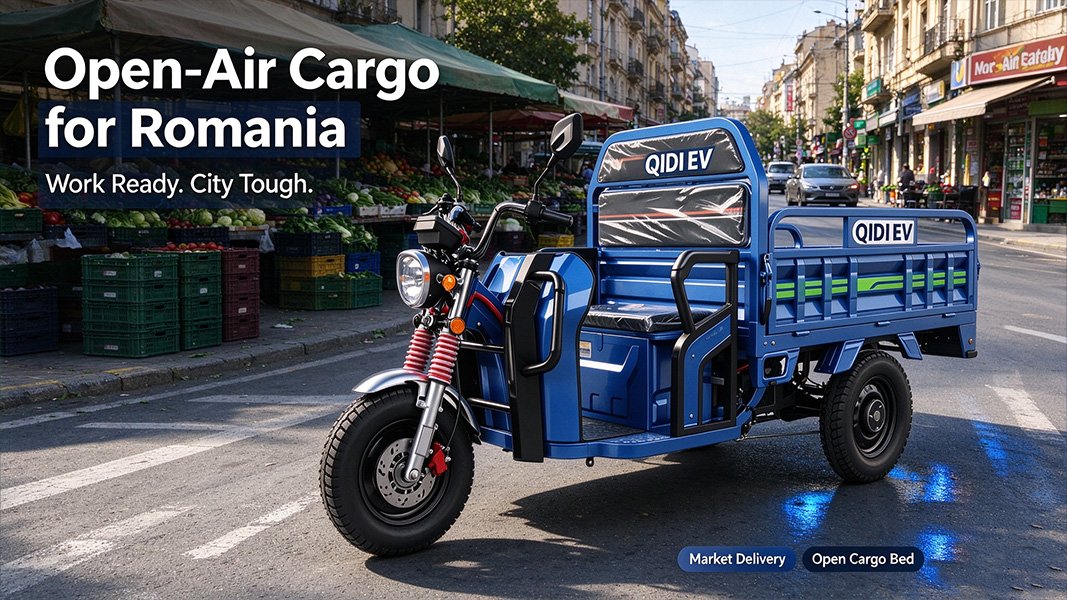
The R1 is designed for customers who need an open flatbed rather than a conventional enclosed cargo box.
The QIDI L2e/L5e range page lists the Land Cruiser R1 as an L5e cargo model with:
- Motor: 72V 1500W
- Maximum speed: 45 km/h
- Listed payload: 585 kg
- Listed price: US$970
Potential applications include:
- Agricultural produce and equipment
- Building materials and tools
- Warehouse and factory transportation
- Gardening and landscaping
- Local commercial deliveries
Customer problem: Fixed cargo boxes are not always convenient for irregularly shaped materials, equipment or larger items.
Why consider R1? Its flatbed configuration gives operators more flexibility when loading different types of goods.
3. Romanian Local Prices: How Competitive Is the Market?
To help distributors understand the local market, we reviewed publicly listed prices from Romanian retailers in November 2026.
These are retail price references, not direct technical equivalents to QIDI models.
| Romanian market category | Publicly listed price examples |
|---|---|
| Basic electric cargo tricycles | RON 6,400–9,990 |
| Larger or enclosed cargo tricycles | RON 10,990–14,990 |
| Four-wheel electric utility pickups | RON 20,650–27,000 |
| Four-wheel electric mobility scooters | Around RON 6,879–12,159 |
Examples include:
- ROC Auto – RDB CARGO electric tricycle: around RON 6,400.
- AMR Elektro – electric cargo tricycles: models listed from approximately RON 6,990 to RON 14,990.
- Bimax – electric cargo tricycles: multiple utility tricycles and cargo models.
- Bimax – electric pickups: utility pickups listed around RON 20,650–26,400.
- Gshop – four-wheel electric scooters: examples around RON 6,879.
These prices reveal several important market characteristics.
First, price competition is strong in the basic cargo tricycle segment. A distributor entering Romania with a standard low-power model must compete with established local retailers.
Second, there is a higher price bracket for enclosed and larger utility vehicles. Customers may pay more when they receive better weather protection, greater cargo capacity, a stronger powertrain or more practical equipment.
Third, four-wheel electric pickups occupy a different purchasing segment. Their price is higher, but they can serve customers whose transport requirements are beyond the practical limits of a basic three-wheel vehicle.
For QIDI distributors, the opportunity is not simply to offer the lowest price. It is to provide a clear difference in approved vehicle category, payload, product quality, spare-parts support and total operating cost.
4. Three Wheels or Four Wheels: Which Is Better for Romanian Businesses?
The choice between an electric cargo tricycle and a four-wheel electric pickup should be based on the customer’s actual work.
| Customer requirement | Better starting point |
|---|---|
| Low-cost local goods transportation | Land Cruiser B10 |
| Flexible flatbed loading | Land Cruiser R1 |
| Higher-capacity professional transportation | NIO A8H |
| Leisure and short-distance passenger mobility | Joyride P100 |
| Narrow farm lanes and small work areas | Cargo tricycle |
| More enclosed cargo protection | NIO A8H |
Advantages of Electric Cargo Tricycles
- Lower entry price than most four-wheel utility pickups.
- Compact size for narrow working areas.
- Practical for small farms, markets and workshops.
- Simple daily charging arrangements.
- Flexible cargo-box or flatbed configurations.
Advantages of Four-Wheel Electric Pickups
- Four-wheel structure for customers who prefer a pickup-style vehicle.
- More enclosed cargo protection on suitable models.
- Better fit for some professional commercial operations.
- Greater potential cargo capacity on appropriately approved models.
- More suitable for customers who need a small utility vehicle rather than a basic three-wheel transporter.
A three-wheel vehicle is not automatically less stable or less capable in every situation, and a four-wheel vehicle is not automatically suitable for every road. Buyers should compare the approved payload, axle loads, braking system, suspension and operating conditions.
5. Import Costs, Container Shipping and Distributor Profitability
For Romanian importers, the purchase price is only one part of the final vehicle cost.
The landed cost should include:
Vehicle price + ocean freight + insurance + customs duty + import VAT + port charges + customs clearance + inland transportation + local preparation.
QIDI currently lists the NIO A8H with a packing reference of four SKD units per 40HQ container. This provides a useful starting point for calculating freight allocation.
For example:
| Container freight quotation | A8H allocation at 4 SKD units |
|---|---|
| US$4,000 | US$1,000 per vehicle |
| US$5,000 | US$1,250 per vehicle |
| US$6,000 | US$1,500 per vehicle |
| US$7,000 | US$1,750 per vehicle |
These are calculation examples, not current freight quotations. Actual container loading for B10, R1 and Joyride P100 must be confirmed using their packaging dimensions and loading plans.
Smaller vehicles may allow more units per container, potentially reducing the freight allocation per unit. However, the final calculation must account for packaging, battery transport requirements and the actual shipping arrangement.
How Long Does It Take to Recover the Investment?
For cargo vehicles, a distributor should calculate two different types of return:
1. Importer or distributor return
The gross margin per vehicle is:
Retail selling price excluding VAT − landed cost excluding recoverable VAT.
The distributor must also deduct sales commissions, warehousing, warranty reserves, local delivery, marketing and operating expenses.
2. End-user operating return
For a business using an electric cargo vehicle, the basic payback formula is:
Vehicle investment ÷ monthly operating-cost savings = simple payback period.
For example, assume a local delivery operator saves RON 0.40 per kilometre compared with its previous vehicle after accounting for energy and routine operating costs. At 1,500 km per month, the estimated saving is RON 600 per month.
A vehicle investment of RON 9,000 would therefore take approximately 15 months to recover through those operating savings alone.
This is an illustrative calculation, not a guaranteed result. Actual savings depend on electricity prices, the previous vehicle’s fuel consumption, cargo weight, mileage, maintenance and financing costs.
Joyride P100 should be evaluated differently. Since it is a passenger mobility product, its commercial return depends on rental income, resort use, fleet utilization or the value of personal mobility—not cargo delivery savings.
6. E-mark, CoC and Vehicle Registration in Romania
All four products are presented within QIDI’s EEC/CoC product range, but buyers must check the exact approval category and certificate for the specific model and configuration.
The categories are important:
- L2e: Light three-wheel moped category.
- L5e: Heavy motor tricycle category, including certain cargo and passenger applications.
- L7e: Heavy quadricycle category, including suitable utility vehicles such as the NIO A8H L7e-CU.
A CoC (Certificate of Conformity) links an individual vehicle to its approved vehicle type. Buyers should request the actual type-approval number and a sample CoC before ordering.
Romanian registration procedures also distinguish between vehicle categories. Under Romania’s Order No. 181/2024, L2e vehicles and L6e light quadricycles are among the categories registered through local authorities. Other vehicle categories may follow different registration procedures.
For this reason, importers should confirm the exact process with the Romanian Automobile Register (RAR) and the relevant registration authority before shipment.
A certificate is not a substitute for checking the vehicle’s exact approved configuration. The vehicle delivered, its identification number, category and CoC documentation must correspond.
7. Frequently Asked Questions
Q1: Is an electric cargo tricycle suitable for Romanian farms?
Yes, for short-distance transportation of tools, produce, feed and other materials. Buyers should check payload, ground clearance, climbing ability and road conditions before selecting a model.
Q2: Is a four-wheel electric pickup better than a three-wheel cargo tricycle?
Not for every application. A three-wheel vehicle is often more affordable and compact. A four-wheel pickup may be preferable for customers needing an enclosed cargo area, a different vehicle structure or greater approved payload.
Q3: Can an L7e electric pickup be used like a conventional delivery truck?
Not automatically. L7e and conventional N1 commercial vehicles are different approval categories. Buyers must check the approved vehicle use, maximum mass, payload and road restrictions.
Q4: Can QIDI vehicles be registered in Romania with a CoC?
A valid EU type approval and matching CoC provide an important basis for registration. The buyer must still follow the Romanian registration procedure applicable to the exact vehicle category and complete the required insurance and administrative steps.
Q5: Which QIDI model is the best choice for a Romanian distributor?
For a price-sensitive cargo market, start by evaluating Land Cruiser B10 and R1. For professional customers requiring a four-wheel electric pickup, consider NIO A8H. For mobility and leisure applications, Joyride P100 addresses a different customer group.
Conclusion: Finding the Right Electric Vehicle Opportunity in Romania
Romania offers opportunities for compact electric commercial vehicles, particularly where customers need affordable transportation for farms, warehouses, local deliveries and private properties.
The Land Cruiser B10 and R1 address practical cargo requirements. The NIO A8H offers a more substantial L7e electric pickup solution for professional utility work. Joyride P100 serves the separate mobility and leisure segment.
For importers and distributors, the most important factors are not just the purchase price. Vehicle approval, local registration, payload, operating costs, container loading and after-sales support all influence long-term profitability.
QIDI welcomes Romanian distributors and commercial buyers to discuss EEC/CoC documentation, model selection, SKD or complete-vehicle supply, and shipping arrangements for the Romanian market.