
Lead Acid vs Lithium Battery for Electric Trucks and Cargo Tricycles
Lead-Acid vs. Lithium Batteries: Which Is Better for Electric Mini Trucks, Farm Vehicles and Cargo Tricycles?
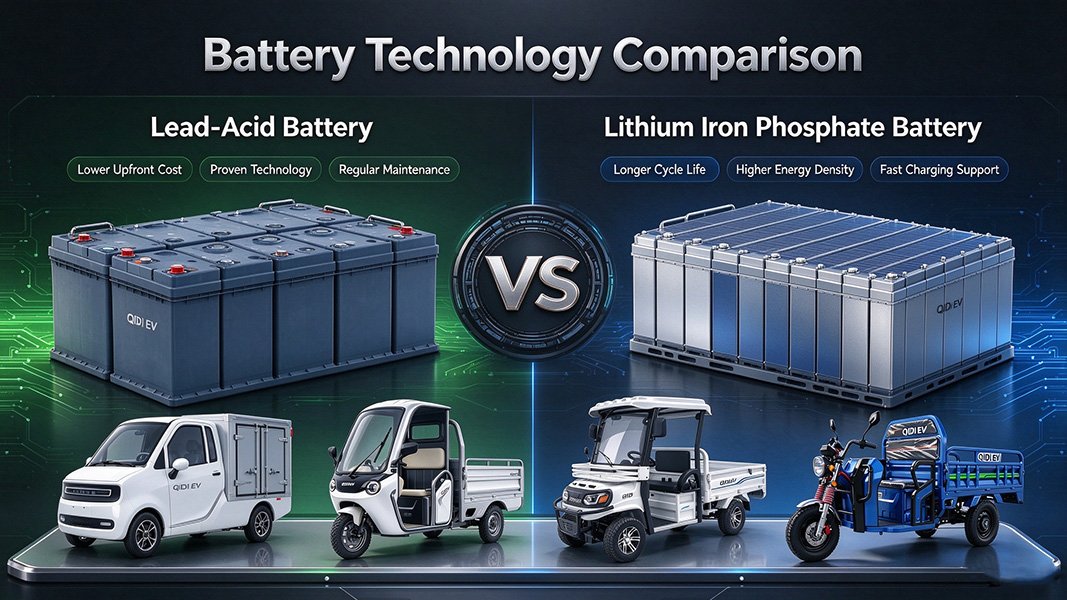
When purchasing an electric mini truck, electric farm pickup or electric cargo tricycle, the battery is one of the most important decisions. It affects driving range, payload efficiency, charging time, maintenance costs, vehicle lifespan and even international shipping arrangements.
For European importers and distributors, choosing between lead-acid and lithium batteries is not simply a comparison of purchase prices. The right choice depends on daily mileage, cargo weight, working conditions, local service capability and the vehicle’s approved configuration.
This guide compares both battery technologies and explains what buyers should check before ordering an electric commercial vehicle from QIDI.
1. Battery Capacity and Driving Range: What Do the Numbers Mean?
Battery capacity is usually expressed in amp-hours (Ah), but Ah alone does not tell you how much energy a battery stores. A more useful comparison is nominal energy:
Battery Energy (kWh) = Voltage (V) × Capacity (Ah) ÷ 1,000
For example, a 72V 100Ah battery has approximately 7.2 kWh of nominal energy.
Here are the battery specifications and manufacturer-published range figures for four QIDI models:
NIO A8H Electric Pickup
Listed battery specification: 72V 120Ah
Nominal energy: 8.64 kWh
Published range: ≥90 km
NIO Mini Electric Pickup
Listed battery specification: 72V 100Ah
Nominal energy: 7.20 kWh
Published range: 100 km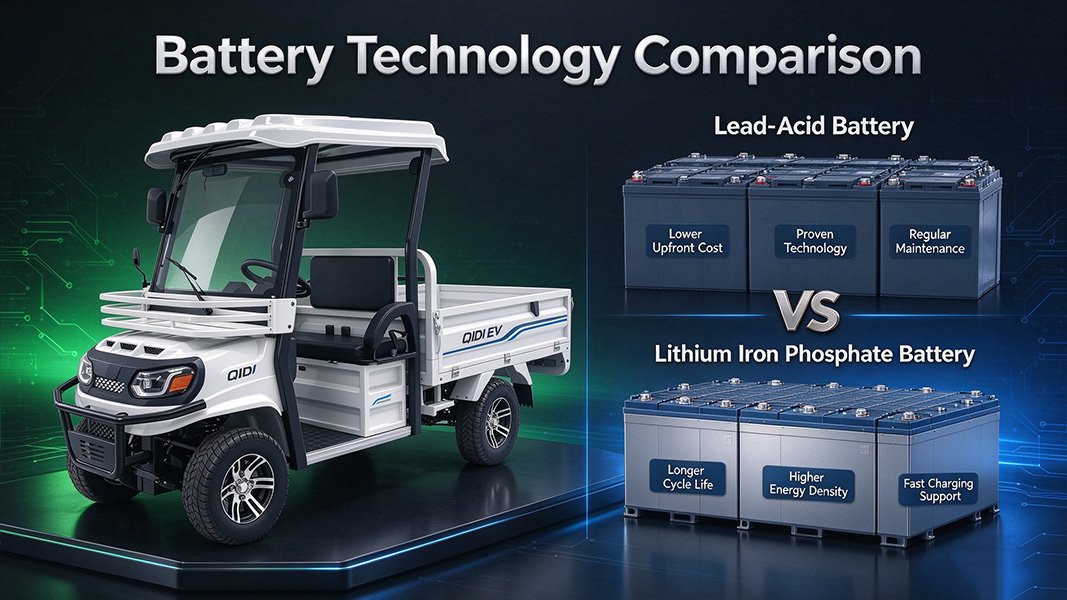
TANK 90 Electric Farm Pickup
Listed battery specification: 60V 80Ah Li-ion
Nominal energy: 4.80 kWh
Published range: 40–80 km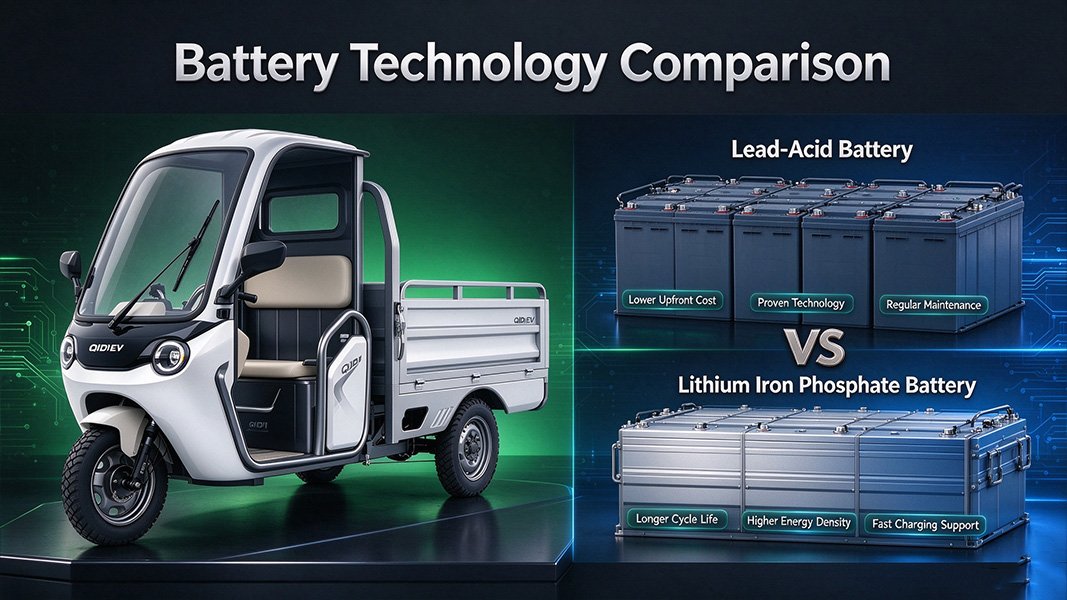
Land Cruiser B10 Cargo Tricycle
Listed battery specification: 72V 58Ah
Nominal energy: 4.18 kWh
Published range: 80–100 km
These are the figures published on the respective QIDI product pages. The NIO A8H and NIO Mini pages specify voltage and capacity but do not clearly identify the battery chemistry in their main specifications. Please confirm the exact lead-acid or lithium configuration when ordering.
Product details:
- NIO A8H Electric Pickup – L7e
- NIO Mini Electric Pickup – L7e
- TANK 90 Electric Farm Pickup
- Land Cruiser B10 Electric Cargo Tricycle
Important: These range figures should not be treated as directly comparable test results. The models have different motor power, vehicle weight, operating speeds and intended applications. A range figure measured at 30 km/h cannot be fairly compared with one measured at 45–55 km/h.
2. How Does a Full Load Affect Electric Vehicle Range?
For electric light trucks and cargo tricycles, the driving range under load is often more important than the range of an empty vehicle.
A fully loaded vehicle generally consumes more energy because the motor must work harder during acceleration, climbing and repeated stopping. Other factors also affect real-world range:
- Cargo weight and passenger load
- Uphill roads, rough surfaces and frequent acceleration
- Driving speed and stop-and-go traffic
- Low temperatures and battery condition
- Tire pressure, vehicle maintenance and driving habits
For example, an electric cargo tricycle delivering parcels on relatively flat city roads may achieve a different range from the same vehicle carrying construction materials uphill.
The published product pages do not provide a standardized full-payload range test for all four models. Buyers should therefore request empty-load, partial-load and maximum-rated-load test results before making a fleet purchase.
A useful supplier test should record the battery configuration, total vehicle and cargo weight, average speed, road conditions, ambient temperature and remaining battery capacity after a defined route.
This is a much more reliable way to compare electric mini truck range than looking at Ah figures alone.
3. Lead-Acid vs. Lithium Batteries: Main Differences
Both technologies can power electric commercial vehicles, but they are designed for different purchasing priorities.
Purchase cost
Lead-acid battery: Usually lower
Lithium battery (especially LiFePO₄): Usually higher
Weight
Lead-acid battery: Heavier
Lithium battery (especially LiFePO₄): Lighter
Usable energy
Lead-acid battery: Generally lower for comparable rated capacity
Lithium battery (especially LiFePO₄): Generally higher
Charging
Lead-acid battery: Usually slower
Lithium battery (especially LiFePO₄): Can support faster charging with a compatible system
Maintenance
Lead-acid battery: Some types require inspection and water maintenance
Lithium battery (especially LiFePO₄): Usually low routine maintenance; requires a suitable BMS
Cycle life
Lead-acid battery: Generally shorter
Lithium battery (especially LiFePO₄): Generally longer
Best fit
Lead-acid battery: Budget-sensitive, lower-intensity operations
Lithium battery (especially LiFePO₄): Frequent use, longer routes and higher utilization
Advantages of Lead-Acid Batteries
Lead-acid batteries remain a practical option for customers who prioritize a lower initial vehicle price.
Their main advantages include:
- Lower upfront battery cost.
- Familiar technology and relatively simple servicing.
- Established availability in many local markets.
- Suitable for short daily routes and lower-intensity operations.
- A mature recycling channel in many regions.
However, lead-acid batteries are heavier and generally offer fewer usable energy cycles than quality lithium packs. Flooded lead-acid batteries also require proper maintenance, including electrolyte-level checks and suitable charging practices.
For best performance, Trojan Battery recommends limiting normal discharge to approximately 20–50% of rated capacity for its deep-cycle lead-acid products, even though deeper cycling is possible.
Advantages of Lithium Batteries
Lithium batteries, particularly LiFePO₄, are increasingly attractive for commercial electric vehicles.
Their advantages include:
- Lower battery weight, helping preserve vehicle payload.
- More usable energy from a comparable nominal capacity.
- Longer cycle life in appropriately designed battery systems.
- Higher charging efficiency and potentially shorter charging periods.
- A battery management system (BMS) that monitors important operating conditions.
For example, Victron’s published LiFePO₄ battery data specifies 2,500 cycles at 80% depth of discharge, 3,000 cycles at 70%, and 5,000 cycles at 50%, with at least 80% of nominal capacity remaining under the stated test conditions.
These figures are examples from a specific battery product, not a guaranteed lifespan for every lithium battery or QIDI vehicle. Battery chemistry, cell quality, temperature, charging habits and BMS design all matter.
4. Battery Lifespan: Which One Lasts Longer?
Battery lifespan can be compared by calendar years, but cycle life provides a more useful technical reference for vehicles that are charged regularly.
As an illustration, one Monbat deep-cycle lead-acid technical datasheet gives approximately 500 cycles at 100% depth of discharge and 1,200 cycles at 50% depth of discharge. By comparison, the Victron LiFePO₄ example above specifies 2,500 cycles at 80% depth of discharge.
The comparison shows why lithium can offer a lower long-term energy-storage cost, even when its initial price is higher.
However, cycle-life figures from different manufacturers are not a direct laboratory comparison. Buyers should request the actual battery datasheet, warranty period and cycle-life test conditions for the battery supplied with the vehicle.
5. Which Battery Is More Suitable for European Businesses?
European buyers generally choose batteries according to operating intensity and total cost of ownership.
The International Energy Agency reports that the European Union accounted for almost 15% of global electric vehicle battery deployment in 2025. Lithium-ion technology is therefore firmly established in Europe’s road EV market, with LFP batteries accounting for more than 10% of EU EV battery demand in that year.
Lead-acid batteries still have a place in price-sensitive, low-speed utility applications, particularly where vehicles travel short distances and can be charged overnight.
Lead-acid may suit:
- Small farms with limited daily driving distances.
- Private estates and garden maintenance.
- Low-intensity warehouse transportation.
- Buyers prioritizing lower initial investment.
Lithium may suit:
- Urban parcel and goods delivery.
- Regularly operated electric cargo tricycles.
- Commercial farms and orchards with longer working hours.
- Industrial facilities requiring frequent vehicle use.
- Fleets where payload, charging efficiency and reduced downtime are priorities.
For European fleet buyers, the important question is not simply which battery is cheaper, but how much the vehicle costs to operate over its expected working life.
6. Battery Type and International Shipping Costs
Battery selection also affects export logistics.
Under the IMO’s IMDG Code 2024 Edition, Amendment 42-24, which became mandatory on 1 January 2026, lithium-ion battery-powered vehicles are listed as UN 3556, Class 9. Vehicles powered by wet batteries are addressed under a different entry, UN 3171.
However, the IMDG Code includes special provisions that may exempt certain battery-powered vehicles from most of its requirements when specified conditions are met, including protection against short circuits. When the relevant exemption does not apply, additional dangerous-goods requirements may be necessary.
This means that lithium-powered vehicles can involve additional shipping documentation, carrier approval, handling arrangements or freight surcharges. But not every lithium-battery vehicle automatically requires a dangerous-goods container booking.
Similarly, a lead-acid battery should not automatically be described as ordinary cargo. Its classification depends on the battery type, whether it is installed or shipped separately, and the applicable transport provisions.
For importers, we recommend comparing shipping quotations based on the same route and container type. Ask the freight forwarder to confirm:
- Whether the complete vehicle qualifies for an IMDG special provision.
- Whether the carrier requires a dangerous-goods declaration or additional battery documents.
- Whether any EV, battery-handling or dangerous-goods surcharge applies.
- Whether the vehicle can be shipped with its battery installed.
In many purchasing situations, lead-acid configurations can be easier and less expensive to arrange for shipping. Lithium configurations may have higher logistics costs on certain routes. The actual difference must be confirmed with the shipping line rather than assumed from battery chemistry alone.
7. Can You Change the Battery After E-Mark or CoC Approval?
This is an important issue for European distributors.
A vehicle’s E-mark or EU type approval applies to a defined approved vehicle type and configuration. The Certificate of Conformity (CoC) confirms that the individual vehicle conforms to that approved type.
For L-category electric vehicles, UNECE Regulation No. 136 covers electrical powertrain and rechargeable electrical energy storage system (REESS) safety. Its approval procedure requires relevant modifications to the vehicle or REESS type to be notified to the original Type Approval Authority for assessment.
Can a customer import the vehicle, register it and then change the battery from lead-acid to lithium?
There is no general EU rule that makes this change automatically legal simply because customs clearance and vehicle registration have been completed.
A like-for-like replacement using an approved equivalent battery may be treated as normal repair or maintenance. However, changing battery chemistry, voltage, capacity, battery management system, charger or installation can affect the approved configuration and vehicle safety.
Depending on the destination country and the extent of the modification, further technical inspection, approval, registration updates or insurance confirmation may be required.
Our recommendation is simple: choose the required battery configuration before production and confirm that it matches the vehicle’s approval documents and CoC. Do not rely on changing the battery after registration as a way to avoid an approval requirement.
8. Frequently Asked Questions
Q1: Is lithium always better than lead-acid for an electric cargo tricycle?
Not necessarily. Lithium is generally better for frequent operation, longer daily routes and payload efficiency. Lead-acid can still be a sensible choice for low-mileage operations with a strict initial budget.
Q2: Does a larger Ah battery always provide a longer driving range?
No. Voltage, nominal energy, motor efficiency, vehicle weight, speed, road conditions and cargo weight also affect range. Compare kWh and real-world test results rather than Ah alone.
Q3: Is a lithium battery worth the higher purchase price?
For vehicles used frequently, a longer service life, lower weight and reduced charging downtime may offset the higher initial cost. For occasional short-distance work, lead-acid may provide better initial affordability.
Q4: Can I order a QIDI vehicle with either battery type?
Battery options depend on the model and its approved configuration. The TANK 90 product page lists a 60V 80Ah lithium-ion battery as standard and a lead-acid option. For other models, confirm the selected battery chemistry and whether that version is covered by the relevant approval before ordering.
Q5: What should I check before importing an electric vehicle into Europe?
Confirm the vehicle category, matching type-approval documentation, CoC availability, battery specification, charger compatibility, spare-parts support and destination-country registration requirements. Also obtain a shipping quotation based on the actual battery configuration.
Conclusion: Choose the Battery for the Job, Not Just the Price
There is no single battery choice that suits every electric vehicle buyer.
Lead-acid batteries offer lower upfront costs for short-distance and low-intensity work. Lithium batteries are often a better long-term choice for commercial fleets that require longer operating hours, lighter vehicle weight and reduced maintenance.
For QIDI electric mini trucks, farm pickups and cargo tricycles, the best purchasing decision should combine driving-range requirements, full-load performance, battery lifespan, transport costs and approval documentation.
Contact QIDI to confirm the available battery configurations, technical specifications and shipping arrangements for your target market before placing an order.