
Electric Mini Trucks in Europe 2026: Export Trends, Types & QIDI EV Solutions
Electric Mini Trucks & Light Pickups in Europe: The 2026 Export Picture
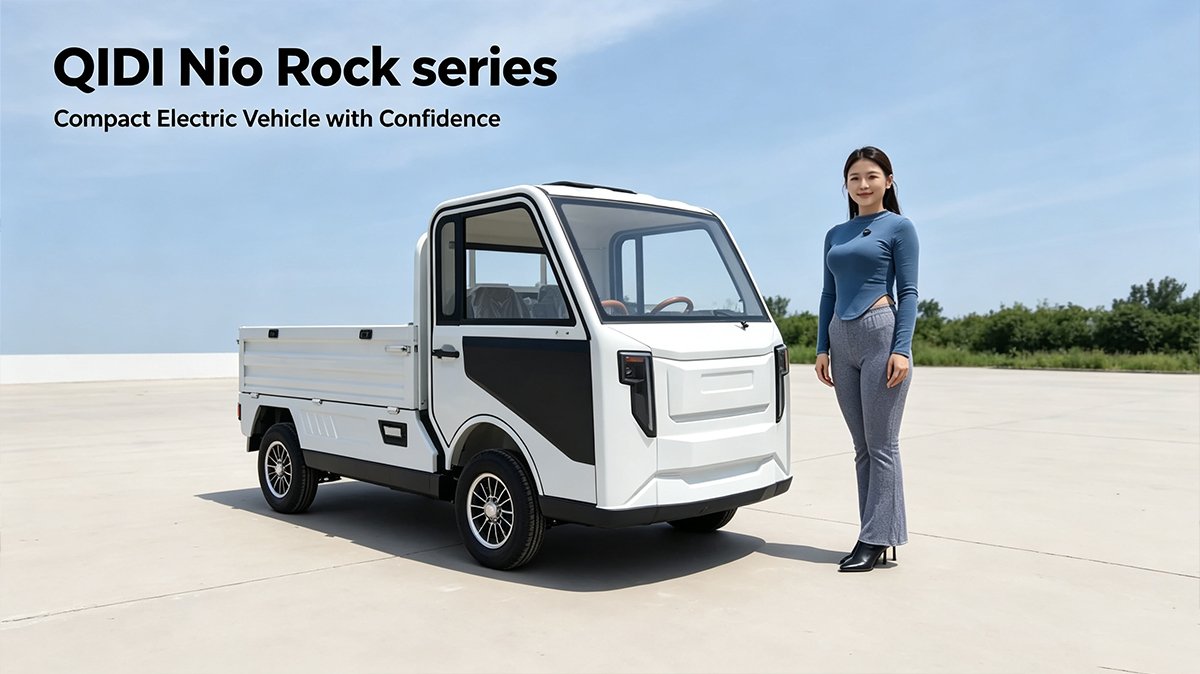
When European fleet managers talk about electrification, the conversation usually starts with vans. But the real action in 2026 is one tier below: the electric mini truck — called a light pickup, light commercial quadricycle, or L7e utility vehicle depending on where you register it.
Compact, narrow, cheaper to run than a diesel van, and able to enter places a 3.5-tonner cannot, this vehicle class is becoming the workhorse of urban last-mile delivery, municipal fleets, industrial yards, and agriculture across the EU, the UK, and beyond. This article breaks down the 2026 export reality: demand, volumes, body-type families, and how QIDI EV’s four-wheel range — including the incoming NIO Rock — actually gets to European customers.
The 2026 Market: Small Vehicles, Big Regulatory Pull
The headline number comes straight from ACEA. In the first half of 2026, the EU registered 742,759 new vans, up 1.9% year on year — a modest recovery from the 13.2% drop in H1 2025. Buried inside that number is the shift that matters: electrically chargeable vans surged 41.6%, taking their share of new LCV registrations from 9.5% to 13.2%. Diesel still accounts for 79.1%, but that is down from 82% a year earlier. The Netherlands is already at 84% electrically chargeable in new LCVs; Germany’s eLCV market is, by contrast, still contracting. The lesson is clear: where regulation bites, electric wins — fast.
What does this mean for the electric mini truck Europe segment? The mini truck sits below the 3.5-tonne eLCV bracket, often in the L6e / L7e quadricycle category under EU Regulation No 168/2013. That distinction is everything:
- L6e: light quadricycle, up to 4 kW, top speed around 45 km/h — ideal for enclosed campuses and resort internal transport.
- L7e: heavy quadricycle, up to 15 kW, goods version up to 600 kg unladen (excluding batteries) — the electric light pickup sweet spot for cargo and utility work.
Countries apply local rules on top: licensing, insurance, where low-speed vehicles may ride. France and Italy have mature L7e frameworks; Germany typically requires TÜV acceptance plus a COC for registration. This is precisely why a type-approved chassis matters more than a low sticker price.
Why Demand Is Concentrating in Certain Countries
Three structural forces:
- Zero-emission zones. Europe now has 300+ low- and zero-emission zones across roughly 19 countries. London’s ULEZ, Paris’s ZFE, Milan’s Area B, Madrid and Barcelona’s ZBE, Amsterdam and Rotterdam’s milieuzones — together they make a diesel van a liability on a city-centre route.
- Last-mile economics. European online retail penetration is approaching a quarter of total retail, and the parcel boom needs vehicles that are cheap per stop, not fast on a motorway.
- Compliance cost. Full EU type approval (WVTA/EEC) plus a per-vehicle COC is now table stakes for road registration — and that filters out the cheap, undocumented imports.
Bottom line: the electric light pickup Europe opportunity is not a niche “golf cart” market. It is the compliance layer sitting underneath the van market — and it is growing faster than the headline LCV numbers suggest.
Export Types: Same Category, Very Different Bodies
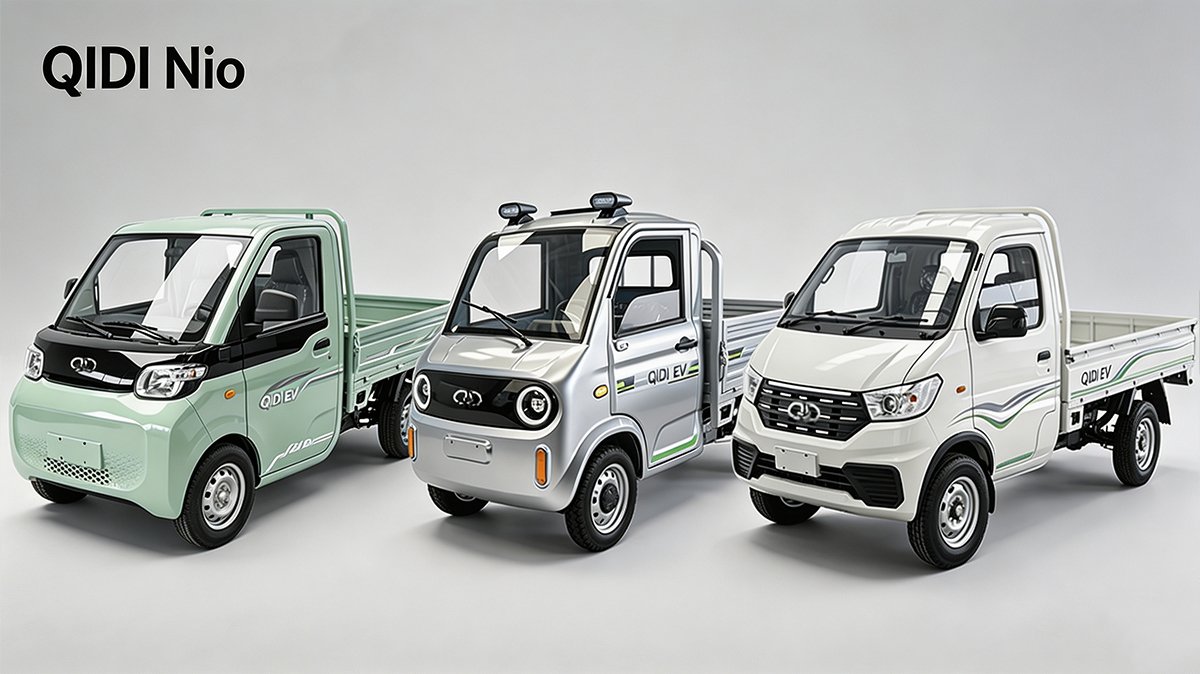
From the outside, every electric mini truck looks the same: four wheels, a small cab, a cargo area. In practice, QIDI EV’s European export mix splits into five distinct body families — each solving a different job.
1. The NIO Rock — New L7e Platform
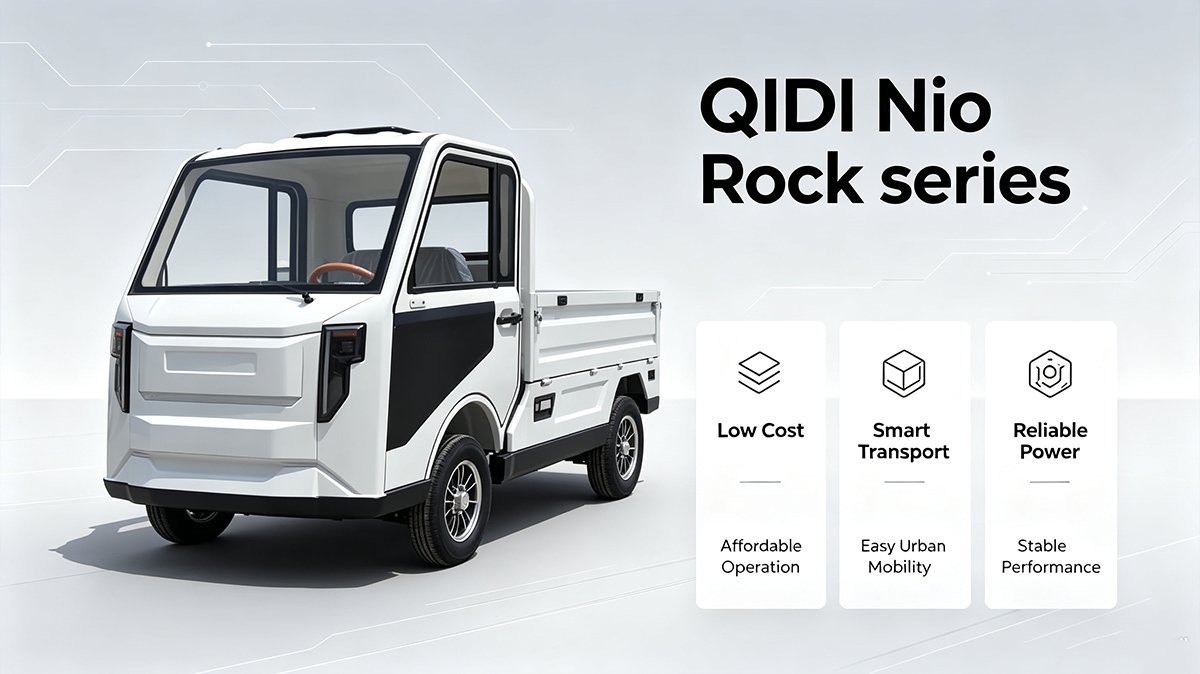
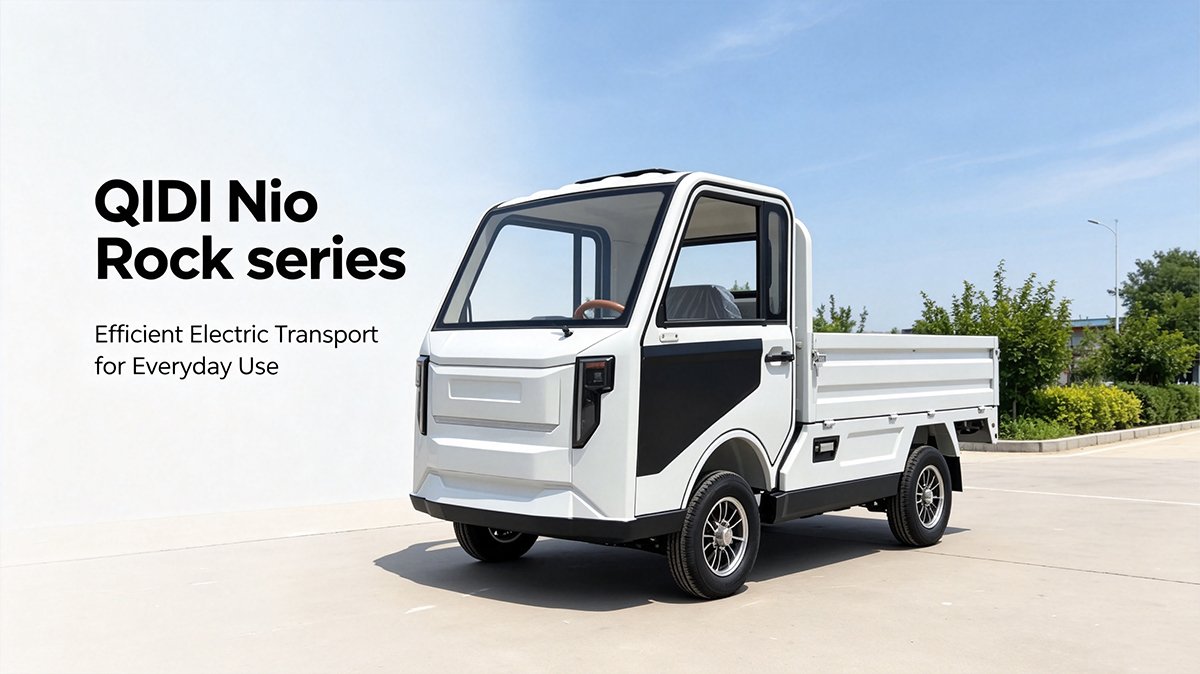
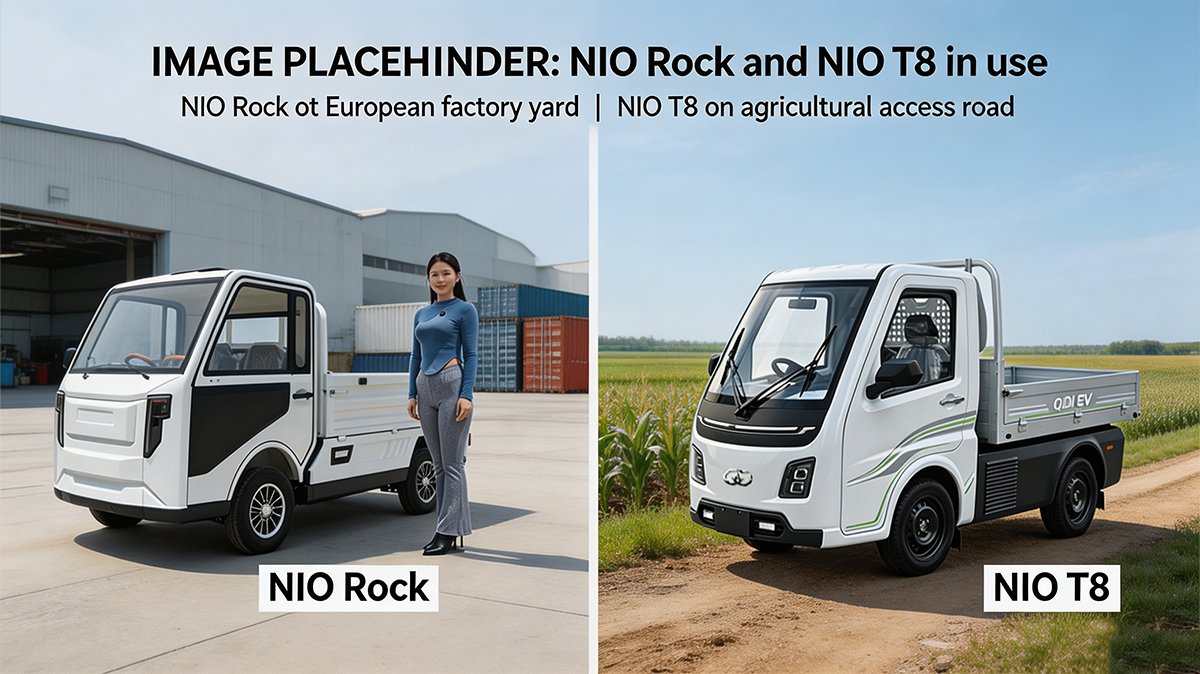
The NIO Rock is QIDI EV’s forthcoming electric light pickup, purpose-built around the L7e heavy-quadricycle format. It is designed for customers who need a road-legal, zero-emission utility vehicle with a proper cargo bed — think municipal maintenance, facility logistics, and small-holder transport.
Key point for buyers: the NIO Rock’s EEC / WVTA type approval is currently in progress (L7e category, COC-based registration). We are not shipping it as a “similar vehicle” or a self-certification workaround. The chassis is going through the full approval track so that the COC matches the VIN, motor number, battery spec, and dimensions exactly — the single detail German KBA and French ANTS registration offices actually check.
Once certified, the NIO Rock gives European distributors a defensible product: a recognisable pickup silhouette with documented road legality, rather than another generic quadricycle.
2. NIO Mini — The Compact Four-Wheeler
The NIO Mini is the entry point: shortest wheelbase, tightest turning circle, suited to factory yards, hotel grounds, campuses, and indoor-outdoor material handling. Where a cargo e-bike cannot carry the load and a van cannot fit through the gate, the NIO Mini sits in the gap.
3. NIO T8 — Mid-Payload Electric Utility Truck
The NIO T8 is the workhorse of the range: longer deck, higher payload, enclosed-cab option. Its core applications are agriculture, forestry support, municipal services, and industrial sites — the jobs where a diesel UTV or a small van has traditionally been the default.
4. NIO MAX — High-Payload Electric Cargo Truck
At the top end, the NIO MAX targets plantations, resorts, and large industrial compounds that need serious cargo volume without a 3.5-tonne footprint. It is the model that makes a four-wheel electric genuinely substitutable for a small diesel truck.
5. Cab-Style Variants
Across the range, the same chassis supports flatbed, enclosed box, tipper, and crew-cab configurations. For European buyers, body style is often more important than horsepower: a closed box for pharmacy runs in the Netherlands, an open flatbed for nurseries in Spain, a tipper for construction yards in Poland.
Export Volumes: What QIDI EV Actually Ships to Europe
Rather than publish a rounded, unverifiable headline number, here is how the electric mini truck export flow actually breaks down for QIDI EV in 2026.
Order Pattern
- Single-unit and small-batch (1–5 units): the dominant entry point. Dealer owners and fleet operators run a trial vehicle for 60–90 days before committing.
- Repeat fleet orders (6–30 units): triggered once range, payload, and serviceability are proven on real routes.
- CKD/SKD container programmes: for established distributors who want local assembly, lower freight per unit, and faster spare-part turnaround.
Geographic Mix
The strongest inbound markets for QIDI four-wheelers in 2026 are Germany, France, Italy, Spain, the Netherlands, Poland, and Belgium, with growing interest from Austria, the Czech Republic, and the Nordics. Southern Europe tends to favour open cargo bodies for agriculture and market work; the Benelux and Germany lean toward enclosed, road-legal L7e configurations for delivery and municipal use.
What This Tells You
The volume story is less about a single big number and more about mix discipline. Body type, payload, battery pack, and certification status change the answer to “how many can you ship” by an order of magnitude. A CBU finished vehicle and a CKD kit do not move in the same container, under the same paperwork, or at the same unit economics — which is exactly why the next section matters.
The Logistics Problem QIDI EV Solves for European Customers
Most importers do not lose on the product. They lose on the gap between factory gate in Tai’an and a registered, road-legal vehicle at their warehouse. That gap has five failure points.
Problem 1: Type Approval and Paperwork
The customer’s position: they need a vehicle they can actually register, not a crate of parts with a vague “CE” sticker.
QIDI EV solution: model-level EEC / WVTA type approval handled through an EU-authorised technical service, plus a per-vehicle COC tied to VIN, motor number, battery spec, and dimensions. For the NIO Rock, this work is in progress now — so early partners join a certified platform rather than inheriting a documentation headache later.
Problem 2: One Vehicle Per Customer vs. One Container
The customer’s position: a trial buyer wants one unit, but ocean freight is priced by the container. Standard shipping leaves the buyer paying for air.
QIDI EV solution: optimised container loading and CKD/SKD knock-down options. A single finished vehicle is packed with a custom loading plan; multi-unit and distributor orders use knocked-down kits that multiply units per container and cut freight per vehicle. The result is a landed cost that makes a small order viable without forcing a buyer into a 40-foot commitment.
Problem 3: Different Countries, Different Configurations
The customer’s position: a Dutch delivery firm needs an enclosed box; a Spanish farmer needs a reinforced suspension and open deck; a Polish industrial client needs a higher payload rating.
QIDI EV solution: configuration engineering before production — battery pack, cargo body, cabin, windshield, and safety accessories are specified against the target country’s intended use. The same NIO platform produces visibly different vehicles at the port, and that is the point.
Problem 4: After-Sales and Parts Availability
The customer’s position: the biggest risk in a Chinese EV purchase is not the first invoice — it is whether wear parts exist in month seven.
QIDI EV solution: a spare-parts supply system and remote technical support built around the European model range. Wear kits, controllers, and LFP battery modules are staged against the parts that actually fail first, so a distributor is not ordering a single brake pad by air freight.
Problem 5: Battery Compliance
The customer’s position: from 18 February 2027, EV batteries above 2 kWh placed on the EU market need a battery passport, and supply-chain due diligence obligations take effect the same year. Get this wrong and the problem shows up at market surveillance, not at the factory.
QIDI EV solution: LFP cell chemistry, full MSDS / UN38.3 transport documentation, and traceability aligned with the EU Batteries Regulation (Regulation (EU) 2023/1542). The two-year delay in due-diligence enforcement is not treated as a reason to wait — documentation is built now, ahead of the deadline.
The pattern across all five problems is the same: the electric mini truck is not the hard part. The hard part is landing a documented, serviceable, compliant vehicle at a predictable cost — and that is the product QIDI EV actually sells.
Where Each Model Fits: A Practical Map
| Model | Body Family | Best-Fit Application | European Angle |
|---|---|---|---|
| NIO Rock | L7e electric light pickup | Municipal maintenance, facility logistics | WVTA/EEC in progress, COC-based registration |
| NIO Mini | Compact four-wheeler | Factory yards, resorts, campuses | Narrow footprint, tight-turn manoeuvrability |
| NIO T8 | Mid-payload utility truck | Agriculture, forestry, industrial sites | Payload + cabin configuration options |
| NIO MAX | High-payload cargo truck | Plantations, large resorts, compounds | Diesel small-truck substitution |
Note: specifications and approval status vary by destination country. Always confirm the latest certification and configuration with your QIDI EV account manager before quoting a customer.
What This Means for European Buyers in 2026
If you are evaluating an electric mini truck for the European market, the decision framework is straightforward:
- Confirm the classification first. L6e, L7e, or full M1/N1 — the answer determines licensing, insurance, and where you can drive.
- Ask for the COC process in writing. No COC path, no road registration. It is that simple.
- Start with one unit. A single DDP trial vehicle de-risks spec, paperwork, and after-sales before you scale to fleet or CKD.
- Spec the body to the route. Enclosed box, open flatbed, or tipper — the right choice is dictated by the job, not the brochure.
- Plan the parts pipeline. The buyers still operating in year two are the ones who ordered wear kits with the first container.
The European electric light pickup market in 2026 is not waiting for permission. With eLCV registrations up 41.6%, zero-emission zones spreading city by city, and the compliance bar rising, the distributors who move now are the ones who will own the aftermarket in 2028.
Conclusion
The electric mini truck Europe story in 2026 is a story of classification, compliance, and logistics as much as horsepower. QIDI EV’s four-wheel range — the incoming NIO Rock L7e pickup, the NIO Mini, NIO T8, and NIO MAX — covers the full span from compact yard vehicles to high-payload cargo trucks, on a single, configurable platform.
From type approval and CKD container loading to battery compliance and spare-part support, the value is delivered at the point the vehicle clears European customs — not the point it leaves the factory.
Looking for the right electric mini truck specification for your country and application? Contact the QIDI EV team for a model sheet, configuration options, and a logistics plan matched to your order size.

NIO Rock L7e type‑approval (EEC/WVTA) is in progress; COC will be issued per VIN after certification. Indicative base‑spec pricing is being positioned around/below US$5,000/unit under agreed incoterms, but this is not a fixed retail price — final quotation depends on battery, body, options, destination, duties and VAT. We’ll confirm availability once the approval dossier is closed.