
Europe Electric Trucks & Farm Pickups: Market and L7e Approval
Electric Mini Trucks and Farm Pickups in Europe: Market Trends, L7e Approval and Buying Guide
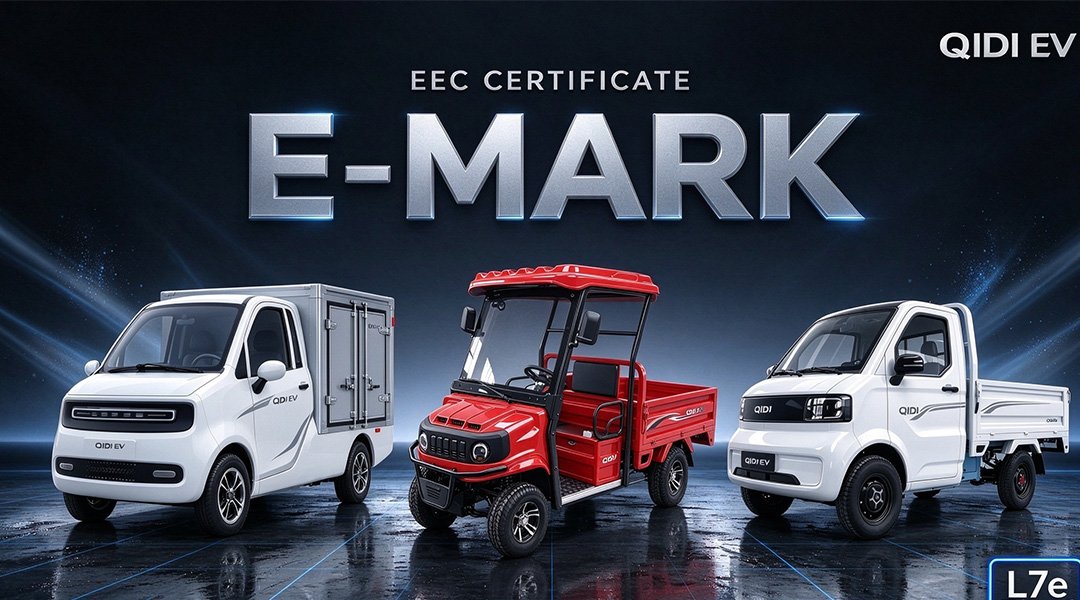
Europe’s commercial transport market is changing. Businesses are looking for vehicles that can reduce daily operating costs, access restricted urban areas and handle practical transport tasks without the purchase price and running costs of a conventional delivery truck.
This creates opportunities for electric mini trucks, electric light-duty pickups and electric farm vehicles. These compact vehicles are particularly suitable for short-distance transportation, property maintenance, agriculture, industrial sites and last-mile logistics.
For European buyers, however, choosing the right vehicle is not simply about battery capacity or price. Vehicle classification, road approval, payload, local registration and shipping costs all matter.
1. Europe’s Electric Light Truck and Mini Truck Market
The European market is developing in two related but different segments:
- Conventional electric light commercial vehicles (eLCVs): electric vans and trucks generally used for professional road transportation.
- Electric quadricycles and utility vehicles: smaller vehicles designed for local transport, private estates, farms, industrial areas and specific commercial applications.
According to the International Energy Agency’s Global EV Outlook 2026, European electric light commercial vehicle sales approached 200,000 units in 2025, increasing by approximately 70% compared with 2024. Europe and China together accounted for around 80% of global electric LCV sales.
ACEA also reported that electrically chargeable vans reached 13.2% of new EU van registrations in the first half of 2026, compared with 9.5% in the same period of 2025.
These figures demonstrate growing demand for electric commercial transport. However, they mainly describe conventional vans and commercial vehicles—not the separate L7e quadricycle or electric farm pickup segment.
For compact electric pickups, the opportunity is more specific: customers need affordable vehicles for short routes, moderate loads and repeated daily operations rather than long-distance freight transportation.
2. Why Are Electric Mini Trucks Attractive to European Businesses?
An electric mini truck is not designed to replace every diesel delivery truck. Its advantage is that it can perform smaller transport tasks more economically.
Lower daily operating costs: Electric motors have fewer moving parts than conventional combustion engines. Businesses can reduce fuel expenses and routine engine maintenance, particularly when vehicles operate predictable daily routes.
Suitable for short-distance operations: Farms, warehouses, factories, hotels and property-management companies often move tools, materials or products within a limited area. A compact electric pickup can complete these tasks without operating a full-size truck.
Compact dimensions: Smaller vehicles are easier to manoeuvre in narrow streets, courtyards, farm lanes and warehouse areas.
Local zero-tailpipe-emission operation: Battery-electric vehicles produce no exhaust emissions while driving. This can be useful for indoor logistics and low-emission operating environments, subject to workplace ventilation, safety and local access rules.
Flexible business applications: Different cargo-box designs and vehicle configurations can support deliveries, maintenance, agriculture, gardening and light industrial transport.
3. Main European Customer Groups and Applications
The strongest potential customers are businesses with frequent, short-distance transport requirements.
Agriculture and livestock farms
Typical application: Feed, tools, produce and equipment transport
Orchards and vineyards
Typical application: Harvest collection and farm maintenance
Warehouses and factories
Typical application: Internal material movement and staff operations
Hotels and resorts
Typical application: Luggage, supplies and maintenance equipment
Property management
Typical application: Landscaping, cleaning and repair materials
Municipal services
Typical application: Park maintenance and local utility work
Urban logistics
Typical application: Short-distance parcel and goods delivery
For these customers, the key purchasing questions are usually practical: How much can the vehicle carry? What is its real working range? Can it operate on the required roads? How easily can replacement parts and technical support be obtained?
A vehicle should be selected according to its actual working environment—not simply its advertised maximum specifications.
4. Understanding L7e Approval: What European Buyers Should Know
One of the most important considerations when importing a compact electric pickup into Europe is its vehicle approval category.
Under EU Regulation 168/2013, L-category vehicles include certain two-, three- and four-wheel vehicles, including light and heavy quadricycles.
The L7e category refers to heavy quadricycles. Within this category, L7e-CU is the heavy quadricycle subcategory designed for utility purposes and goods transportation.
This distinction matters because an L7e-CU electric utility pickup is not automatically equivalent to a conventional N1 light commercial truck. Buyers should compare vehicles according to their approved category and intended use.
How can an L7e CoC help with vehicle registration?
A valid Certificate of Conformity (CoC) is issued by the manufacturer for a vehicle that conforms to its approved EU vehicle type. It connects the individual vehicle to the relevant type-approval requirements.
For a vehicle with valid EU type approval and a matching CoC, the document can provide an important basis for registration in EU Member States. The European Commission explains that Member States cannot refuse registration of a vehicle accompanied by a valid CoC proving compliance with EU law.
However, buyers should understand three important points:
- The certificate must match the exact vehicle type, variant and configuration being imported.
- L7e approval does not automatically grant unrestricted access to every road, motorway or commercial operating area.
- Registration administration, insurance, taxes, number plates and local operating rules still need to be checked in the destination country.
Important: An L7e certificate is not a universal international vehicle passport. It should not be assumed to replace the separate approval requirements of non-EU markets.
For distributors, the safest approach is to request the actual type-approval documentation and a sample CoC before placing a large order.
5. QIDI Electric Pickups and Farm Vehicles for European Buyers
QIDI offers several compact electric four-wheel vehicles for different business requirements. The following models are listed on our website with their respective approval information.
NIO A8H – Electric Pickup for Higher-Capacity Utility Work

The NIO A8H is designed for urban logistics, industrial facilities, estates and professional material transportation.
- Motor: 72V 5000W
- Battery: 72V 120Ah
- Listed driving range: ≥90 km
- Maximum speed: 52 km/h
- Listed loading capacity: 1,183 kg
- Approval listed on product page: EEC / CoC / L7e-CU
→Product page: NIO A8H Electric Pickup
NIO Mini – Compact Electric Pickup for Urban Operations

The NIO Mini is a smaller electric pickup suitable for short-distance delivery, property management, warehouses and local business transportation.
- Motor: 72V 4000W
- Battery: 72V 100Ah
- Listed driving range: 100 km
- Maximum speed: 55 km/h
- Cargo box: 1800 × 1300 × 550 mm
- Approval listed on product page: EEC / CoC / L7e-CU
Product page: NIO Mini Electric Pickup
TANK 90 – Electric Farm Pickup for Agricultural Work

The TANK 90 is developed for farms, orchards, gardens, estates and light-duty site transportation. Its compact structure is suitable for moving agricultural supplies, tools and harvested products.
- Motor: 1500W
- Battery: 60V 80Ah lithium battery
- Listed driving range: 40–80 km
- Maximum speed: 30 km/h
- Listed loading capacity: 300 kg
- Approval information shown on product page: ECE / CoC
Product page: TANK 90 Electric Farm Pickup
Certification note: The current TANK 90 product page lists ECE / CoC, but does not explicitly identify an L7e-CU category in its specification table. Buyers should confirm the exact approval category from the vehicle’s certificate before treating it as an L7e vehicle.
Actual range and load performance depend on road conditions, temperature, cargo weight, battery configuration and driving habits. Buyers should also confirm the approved maximum mass and payload in the official technical documents.
6. Importing Electric Mini Trucks into Europe: Shipping and Cost Considerations
For European distributors, container loading efficiency has a direct effect on the landed cost per vehicle.
QIDI’s indicative shipping arrangements are:
Complete electric four-wheel vehicles
Loading reference: 5 units / 40HQ
Estimated ocean freight per vehicle: US$800–1,400
TANK 90 farm vehicles in SKD form
Loading reference: 16 units / 40HQ
Estimated ocean freight per vehicle: US$250–437.50
The calculation uses an indicative 40HQ ocean freight range of US$4,000–7,000.
For example, if a container costs US$5,000 to ship, the estimated freight allocation is approximately US$1,000 per complete vehicle when loading five vehicles, or US$312.50 per SKD farm vehicle when loading sixteen units.
These are planning estimates, not fixed shipping quotations. Actual loading depends on vehicle dimensions, packaging, battery handling requirements and container arrangement.
Ocean freight also does not include all destination expenses. Buyers should budget separately for port handling, customs clearance, import duty, VAT, inland transportation, insurance and any required assembly or inspection.
Before importing, distributors should confirm the correct customs classification with a qualified customs broker. A vehicle’s customs code should be determined by its technical construction and applicable tariff rules, not selected simply because it appears to offer a lower duty rate.
7. Electric Mini Truck vs. Electric Farm Pickup: Which Should You Choose?
The right choice depends on the customer’s working environment.
- Choose a NIO A8H when the business needs a more powerful utility pickup for regular material transportation.
- Choose a NIO Mini when compact dimensions, urban manoeuvrability and local delivery are the main priorities.
- Choose a TANK 90 when the main requirement is economical transportation around farms, orchards, gardens and private estates.
For distributors, it is also worth considering whether customers need a complete vehicle or an SKD solution. Complete vehicles can simplify the initial supply process, while SKD packing can improve container loading efficiency and may support local assembly operations where the importer has the required facilities and compliance arrangements.
8. Frequently Asked Questions
Q1: Can an L7e electric pickup be registered in every European country?
A valid EU type approval and matching CoC provide an important basis for registration across EU Member States. However, the buyer must still complete the relevant national registration, insurance and tax procedures and comply with local operating rules.
Q2: Is an L7e electric pickup the same as an N1 electric truck?
No. L7e is a heavy quadricycle category under Regulation (EU) 168/2013. N1 is a different category for light commercial vehicles under a separate approval framework. Buyers should not treat the two categories as interchangeable.
Q3: Are electric mini trucks suitable for European farms?
They can be suitable for short-distance farm transportation, orchard work, equipment movement and estate maintenance. Buyers should compare payload, ground clearance, climbing ability, battery capacity and the vehicle’s approved operating category.
Q4: Is SKD importing cheaper than importing complete vehicles?
SKD packing can reduce the freight allocation per vehicle when more units fit into one container. However, the buyer should also calculate assembly labour, facilities, quality control, parts management and any local compliance requirements.
Q5: What documents should a European importer request before ordering?
At minimum, request the applicable type-approval certificate, a sample CoC, technical specifications, VIN and identification information, battery documentation, commercial invoice, packing list and shipping documents. The final document list depends on the vehicle category and destination country.
Conclusion: Choose the Right Electric Utility Vehicle for Your Market
The European market offers opportunities for electric mini trucks and farm pickups, particularly where businesses need compact vehicles for local transportation rather than conventional long-distance freight.
For buyers, the most important decision is to match the vehicle’s approved category, load capacity, range and intended application with local registration requirements.
With the NIO A8H, NIO Mini and TANK 90, QIDI provides different electric utility solutions for urban logistics, industrial operations and agricultural transportation.
Looking for an electric mini truck supplier for the European market? Contact QIDI to discuss vehicle specifications, approval documentation, complete vehicle or SKD supply, and container shipping arrangements.